
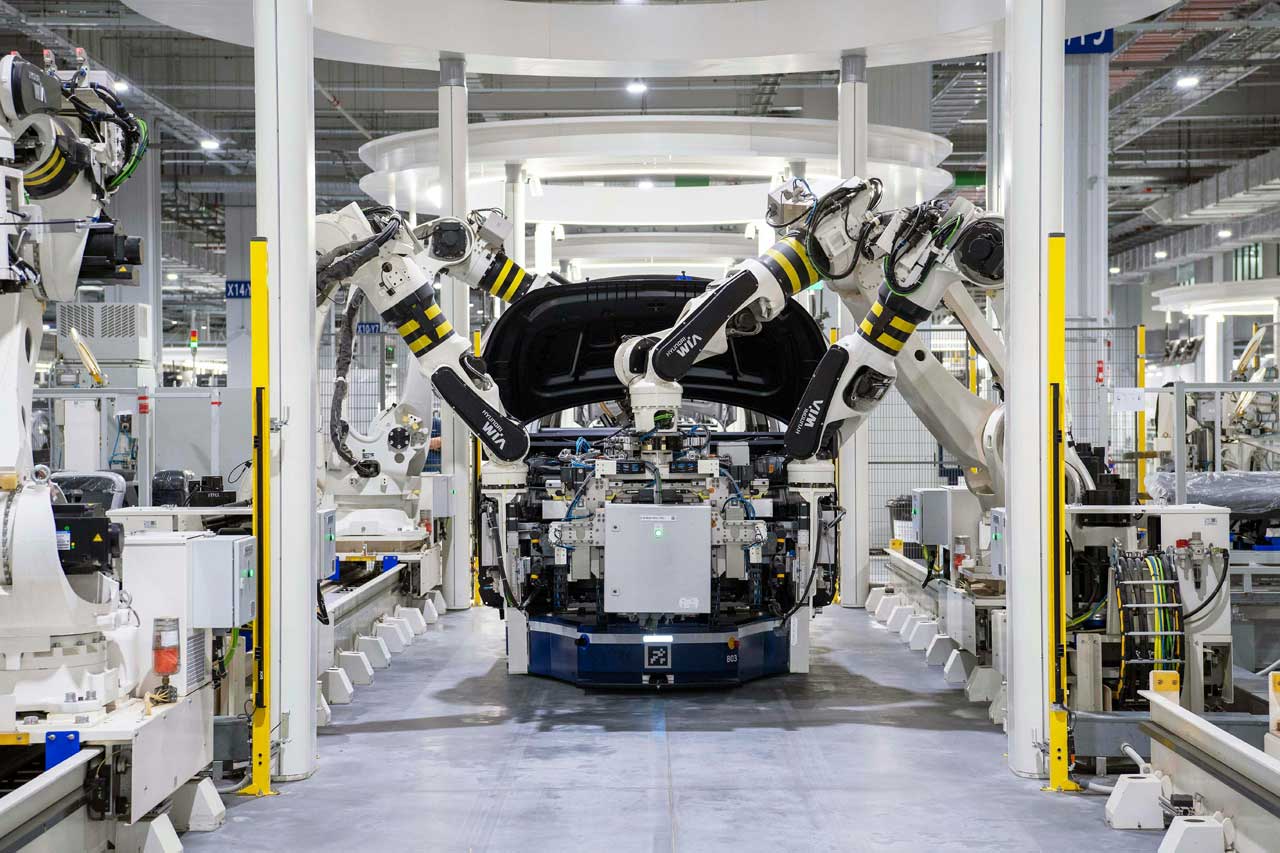
Manufacturing. Pixabay Image.
This page presents Rivian Automotive’s capital expenditures (CapEx) and also the CapEx-to-operating cash flow ratio to evaluate the company’s financial capacity for self-funded expansion.
Let’s dive in!
For other key statistics of Rivian Automotive, you may find more resources on this page: Rivian key stats.
Please use the table of contents to navigate this page.
Table Of Contents
Definitions And Overview
Insight & Summary of Observed Trends
Z1. Insight & Summary of Rivian’s Capital Expenditures (CapEx)
Capital Expenditure Statistics
CapEx Numbers & Growth
A1. Capital Expenditures and CapEx Growth
CapEx vs Cash Flow
A2. Operating Cash Flow and CapEx as % of Operating Cash Flow
Reference, Credits, and Disclosure
S1. References and Credits
S2. Disclosure
Definitions
To help readers understand the content better, the following terms and glossaries have been provided.
Capital Expenditures: Capital Expenditures (CapEx) represent the strategic deployment of capital by an enterprise to acquire, upgrade, or maintain long-term physical or intangible assets. These investments – spanning property, plant, equipment (PP&E), technology infrastructure, and significant facility expansions — are fundamentally designed to expand operational capacity, drive future revenue growth, or secure long-term competitive advantages.
Unlike Operating Expenses (OpEx), which are fully deducted in the period they are incurred to sustain day-to-day operations, CapEx is capitalized on the balance sheet and depreciated or amortized over the asset’s useful life.
In essence, CapEx is a critical metric used to evaluate a management team’s reinvestment discipline. It serves as the primary bridge between operating cash flow and free cash flow, revealing whether an enterprise is actively building sustainable, long-term enterprise value or merely spending to maintain its current operational baseline.
As of fiscal year 2025, Rivian has made substanal investments in its facilies, including recent upgrades to the Normal Factory to support the integraon of R2, and Rivian intends to connue making investments, including technology updates, to drive growth as it scales vehicle producon and deliveries, expand its offerings, and strengthen its core capabilies.
As Rivian invests in its business for long-term growth, leading to increases in operang expenses as well as capital expenditures, it may experience manufacturing shutdowns and addional losses, which could delay its ability to achieve profitability and posive operang cash flow.
Insight & Summary of Rivian’s Capital Expenditures (CapEx)
The following analysis consolidates the trends observed across Rivian’s capital expenditure for the 2019–2025 period.
-
CapEx Trajectory: Pre-Production Surge, Post-IPO Discipline, Renewed Acceleration Rivian’s capital expenditure history divides into three distinct phases. The pre-production and ramp phase (FY2019–FY2021) saw capex explode from $199M to $1,794M — a 9x increase — as Rivian built out the Normal, Illinois manufacturing facility ahead of first deliveries. The post-IPO discipline phase (FY2022–FY2023) saw capex decline for two consecutive years, from $1,369M to $1,026M (-23.7% and -25.1% respectively), reflecting the completion of initial facility build-out and a more conservative capital posture following the difficult FY2022 public market environment for growth companies.
The renewed acceleration phase (FY2024–FY2025) shows capex climbing again — $1,141M (+11.2%) and $1,710M (+49.9%) — which corresponds directly to the Georgia manufacturing facility construction and R2 platform tooling investment discussed in the prior production and revenue analyses. The FY2023–FY2025 average capex of $1,292M and average growth of 12.0% captures this inflection from contraction to renewed expansion.
-
Operating Cash Flow: Persistent and Substantial Burn, But Improving Net cash used in operations has been negative in every year of the dataset, peaking at -$5,052M (FY2022) before improving meaningfully to -$4,866M (FY2023), -$1,716M (FY2024), and -$779M (FY2025) — a trajectory of dramatically narrowing cash burn. The FY2023–FY2025 average of -$2,454M (matching the three-year average cited in the prior financial standing analysis) masks the magnitude of improvement: FY2025’s -$779M burn is 84.6% smaller than FY2022’s peak burn.
This improving OCF trajectory directly parallels Rivian’s gross margin recovery — as automotive and software gross margins improved toward breakeven, the cash consumed by core operations correspondingly declined. If this trend continues, Rivian could approach operating cash flow breakeven within the next 2–3 fiscal years.
-
CapEx as % of Operating Cash Flow: A Volatile and Counter-Intuitive Metric This ratio requires careful interpretation because both the numerator (capex, always positive) and denominator (operating cash flow, always negative across the dataset) combine to produce a metric whose sign and magnitude reflect two separate dynamics rather than a clean “capital intensity” measure. The ratio’s volatility — from -21.1% (FY2023) to -219.5% (FY2025) — is driven primarily by the rapidly shrinking denominator (improving OCF) rather than capex itself.
In FY2025, capex of $1,710M against operating cash outflow of only -$779M produces a ratio magnitude of 219.5% — capex now exceeds the operating cash burn by more than 2x, a structural shift from FY2022–FY2023 when operating losses were so large that capex represented a comparatively smaller share. The FY2023–FY2025 average ratio of -102.4% reflects this transition: as OCF improves toward breakeven, capex is increasingly the dominant driver of total cash consumption rather than core operating losses.
-
The Combined Cash Burn Picture Total cash consumption — operating cash flow plus capex — provides the cleanest read of Rivian’s overall cash trajectory: -$552M (FY2019, OCF -$353M + capex $199M… actually combined burn), peaking around -$6,421M (FY2022, -$5,052M + $1,369M), and narrowing to -$2,495M (FY2024) before re-expanding to -$2,489M (FY2025, OCF -$779M + capex $1,710M) as renewed capex investment offsets the OCF improvement. This combined view confirms that while operational cash burn has genuinely improved, total cash consumption has plateaued around $2.5B annually as the Georgia facility investment ramps — meaning the balance sheet cash depletion rate has not improved as much as the OCF-only trend suggests.
-
Structural Takeaway: Rivian’s capital expenditure profile reflects a company in transition between two major investment cycles: completing the initial Normal, Illinois ramp (FY2019–FY2021), pausing for discipline (FY2022–FY2023), and now funding the next phase of growth through Georgia facility construction and R2 platform tooling (FY2024–FY2025 onward). The combination of improving operating cash flow and renewed capex growth is a double-edged signal — operationally encouraging (core losses narrowing) but capital-intensity concerning (total cash burn not meaningfully declining due to reinvestment).
For FY2026–FY2028, capex is likely to remain elevated or increase further as Georgia facility construction reaches peak spending and R2 production tooling is finalized — plausibly in the $1.8B–$2.5B annual range based on comparable EV manufacturing facility investment patterns. Operating cash flow should continue improving if the gross margin recovery trajectory holds, potentially approaching breakeven by FY2027–FY2028 if software and services margin expansion continues at the current pace.
The capex-to-OCF ratio will likely remain volatile and should not be over-interpreted as a standalone signal; investors should instead track the combined cash burn figure (OCF + capex) as the more meaningful indicator of balance sheet runway, alongside the debt maturity schedule discussed in the prior financial standing analysis — particularly given the FY2029–FY2030 debt wall that will require either improved self-funding capacity or additional capital access by that point.
The table below combines all Rivian’s capital expenditure metrics into a single view for the latest three fiscal years.
Rivian’s CapEx, Cash Flow & Ratio — Averages (FY2023–FY2025)
| Metric | Average (FY2023–FY2025) |
|---|---|
| CapEx and Growth | |
| Capital Expenditures | $1,292M |
| CapEx Growth | 12.0% |
| Cash Flow and CapEx Ratio | |
| Net Cash Provided by Operations | -$2,454M |
| CapEx as % of Operating Cash Flow | -102.4% |
Capital Expenditures and Growth
Rivian’s CapEx and Growth — Averages (FY2023–FY2025)
| Metric | Average (FY2023–FY2025) |
|---|---|
| Capital Expenditures | $1,292M |
| CapEx Growth | 12.0% |
Operating Cash Flow and CapEx as % of Operating Cash Flow
Rivian’s Cash Flow and CapEx Ratio — Averages (FY2023–FY2025)
| Metric | Average (FY2023–FY2025) |
|---|---|
| Net Cash Provided by Operations | -$2,454M |
| CapEx as % of Operating Cash Flow | -102.4% |
References and Credits
1. All financial figures presented were obtained and referenced from Rivian Automotive, Inc.’s quarterly and annual reports published on the company’s investor relations page: Rivian Investor Relations.
2. Pixabay Images.
Back To Table Of Contents
Disclosure
We may use the assistance of artificial intelligence (AI) tools to produce some of the text in this article. However, the data is directly obtained from original sources (usually the annual and quarterly reports) and meticulously cross-checked by our editors multiple times to ensure its accuracy and reliability.
If you find the information in this article helpful, please consider sharing it on social media. Additionally, providing a link back to this article from any website can help us create more content like this in the future.
Thank you for your support and engagement! Your involvement helps us continue to provide high-quality, reliable content.