
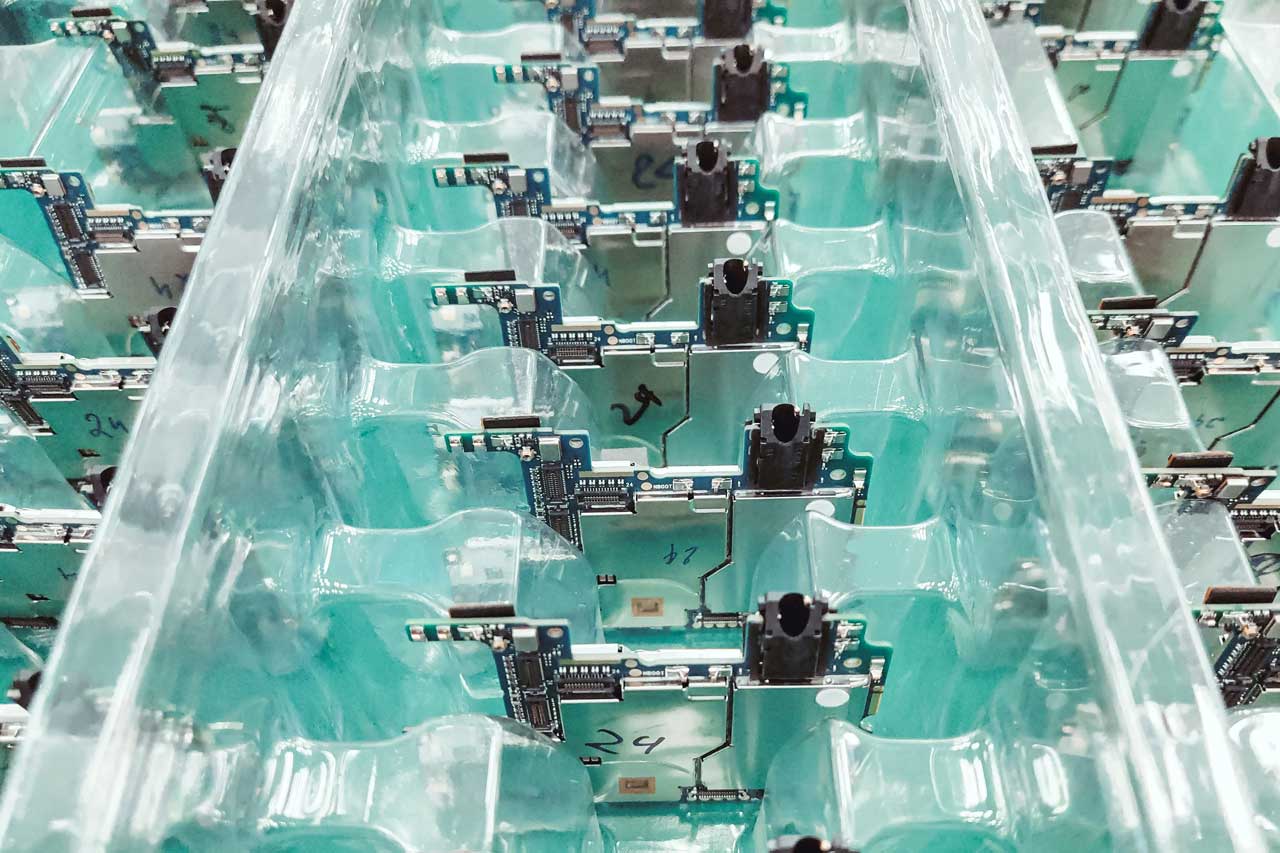
Electronics. Pexels Image.
At their core, Arm Holdings and Intel Corporation represent the most fundamental architectural and operational divide in the semiconductor world.
Arm operates on an intellectual property (IP) licensing model, functioning essentially as the research and design “architect” for the industry. Arm does not manufacture, package, or sell physical microchips. Instead, its engineers develop highly power-efficient processor architectures and instruction sets (the RISC-V competing Arm architecture). They monetize this intellectual property by charging global tech companies upfront or subscription fees to access these blueprints, followed by a recurring royalty fee—usually a small percentage of the final chip price—every single time a customer physically manufactures and ships a device containing Arm technology. Because Arm only sells digital designs, its business model boasts staggering gross margins (often exceeding 95%) and carries zero inventory or factory maintenance risk.
Intel, by contrast, historically pioneered and still primarily operates under an Integrated Device Manufacturer (IDM) model — though it has structurally split into Intel Products and Intel Foundry. Unlike Arm, Intel is a vertically integrated giant that designs, brands, markets, and traditionally manufactures its own physical silicon hardware using its proprietary, high-performance x86 architecture. Intel makes its money the traditional way: by selling physical CPUs and server processors directly to PC manufacturers (OEMs), data center operators, and retail consumers. However, owning and operating cutting-edge fabrication facilities (fabs) is astronomically capital-intensive, requiring tens of billions of dollars in recurring factory upgrades. This leaves Intel exposed to massive cyclical market risks, inventory backlogs, and lower gross margins (typically around 40% to 50%) due to the heavy physical costs of manufacturing silicon wafers.
While their underlying business models diverge completely, both semiconductor pioneers deploy immense capital into research and development to sustain their leadership in global technological innovation.
This analysis evaluates the research and development (R&D) profiles of both companies, comparing their total R&D expenditures alongside key financial metrics such as R&D-to-revenue and R&D-to-operating-expense ratios.
Let’s dive in!
For other key statistics of Arm and Intel, you may find more resources on these pages: Arm key stats and Intel key stats.
Please use the table of contents to navigate this page.
Table Of Contents
Definitions And Overview
Insight & Summary of Observed Trends
Z1. Insight & Summary of Arm and Intel’s R&D Comparison
R&D Statistics
Arm vs Intel
A1. R&D Spending
A2. R&D Growth
A3. R&D to Revenue Ratio
A4. R&D to Gross Profit Ratio
A5. R&D to OpEx Ratio
Reference, Credits, and Disclosure
S1. References and Credits
S2. Disclosure
Definitions
To help readers understand the content better, the following terms and glossaries have been provided.
R&D Expense: Research and Development (R&D) Expense represents the total amount of money a company spends to discover, design, and develop new products, technologies, or services, or to significantly improve its existing ones.
In the tech and semiconductor industries, R&D expense is widely considered the lifeblood of a company. It tracks how much capital is actively being reinvested into future innovation rather than current operations.
1. What is Included in R&D Expense?
R&D is not a single line item of raw cash; it is a department-wide operational expense (OpEx) that typically bundles together:
-
Labor and Salaries: The biggest component—wages, benefits, and bonuses paid to research scientists, software engineers, chip architects, and lab technicians.
-
Stock-Based Compensation (SBC): Equity or stock units granted to R&D talent to retain them over long periods.
-
Equipment and Infrastructure: The cost of specialized design software (like Electronic Design Automation tools), lab equipment, prototyping materials, and dedicated testing facilities.
-
Contracted Services: Fees paid to outside research firms, universities, or third-party consultants collaborating on a project.
2. The Unique Accounting Rule for R&D
Unlike physical assets (like a factory or a delivery truck) which are capitalized and depreciated slowly over many years, R&D costs must be expensed immediately in the period they occur under US GAAP accounting rules.
- The Accounting Logic: Because scientific research is inherently risky, there is no guarantee that spending $100 million on a new AI chip design today will successfully result in a profitable product tomorrow. To keep corporate balance sheets honest, accountants force companies to subtract R&D costs from their revenues right away.
Therefore, a massive spike in R&D spending will immediately lower a company’s reported Net Income for that quarter, even if that research secures their market dominance for the next decade.
3. Key Financial Ratios Used to Analyze R&D
Investors rarely look at R&D spending in a vacuum. To measure how efficiently a company handles its innovation, they use a few key benchmarks:
R&D-to-Revenue Ratio (R&D Intensity)
$$\text{R&D Intensity} = \left( \frac{\text{Total R&D Expense}}{\text{Total Revenue}} \right) \times 100$$
- This tells you what percentage of every dollar earned is plowed straight back into research. For traditional manufacturing or retail companies, this might be 1% to 3%. For high-tech semiconductor firms like Arm or AMD, it routinely climbs between 15% to 30%+.
R&D-to-Operating Expenses (OpEx) Ratio
$$\text{R&D-to-OpEx} = \left( \frac{\text{Total R&D Expense}}{\text{Total Operating Expenses}} \right) \times 100$$
- This measures a company’s internal priorities. It shows whether a tech firm is focusing its overhead budget on inventing things (high R&D) or on marketing and selling existing products (high SG&A—Selling, General, and Administrative expenses).
Summary: Value vs. Cost
While a standard expense (like rent or utility bills) is a pure drain on cash, R&D expense is viewed by Wall Street as an investment. If a tech giant slashes its R&D budget to boost its short-term profits today, it risks falling behind competitors and becoming obsolete tomorrow.
Insight & Summary of Arm and Intel’s R&D Comparison
The following analysis consolidates the trends observed across Arm and Intel in R&D comparison, consisting of R&D spending, growth, and several ratios for the 2021–2025 period.
-
R&D Spending: Diverging Trajectories at Different Scales Intel outspends ARM by approximately 5–6x in absolute R&D dollars throughout the dataset — $13,774M (FY2025) versus ARM’s $2,776M — reflecting Intel’s position as a vertically integrated product company operating across CPUs, GPUs, networking, and foundry services. However, the directional trends are sharply opposed: Intel’s R&D has declined from its FY2022 peak of $17,528M to $13,774M (FY2025), a -21.4% reduction in absolute spending, while ARM’s has grown from $1,133M (FY2022) to $2,776M (+145.1% over the same period).
The FY2023–FY2025 averages of $15,455M (Intel) and $2,275M (ARM) confirm this structural divergence — Intel is contracting its R&D base while ARM is expanding aggressively. Intel’s R&D reduction is directly tied to its restructuring programme (targeting $10B in annualised cost reductions by FY2025) and a strategic focus on fewer, higher-priority projects, principally the 18A process node and the Arrow Lake/Panther Lake product roadmap. The -7.4% average annual R&D growth for Intel in FY2023–FY2025 is the most significant contraction of any company in this comparative R&D series.
-
R&D to Revenue: ARM’s Reinvestment Intensity vs. Intel’s Declining Efficiency Intel’s FY2023–FY2025 average R&D-to-revenue ratio of 29.0% appears moderate — less than ARM’s 56.4% — but this comparison is misleading in isolation. Intel’s revenue has itself been declining (from $54.2B in FY2022 to $52.7B in FY2025), so the ratio reflects simultaneous contraction in both numerator and denominator. A declining R&D-to-revenue ratio in the context of falling absolute R&D spend and falling revenue does not signal improved capital allocation efficiency; it signals a business under pressure reducing investment.
ARM’s 56.4% average R&D-to-revenue ratio, by contrast, reflects an IP-licensing company deliberately reinvesting more than half of each revenue dollar into architecture development, which is structurally appropriate for its business model. The contrast is qualitatively as important as the quantitative gap: ARM is growing revenue (+22.5% avg FY2023–FY2025) while investing more intensely; Intel is shrinking revenue while investing less.
-
R&D to Gross Profit: The Starkest Contrast in the Dataset The R&D-to-gross-profit ratio is where Intel’s structural crisis is most quantitatively visible. Intel’s FY2023 ratio of 73.9% escalated to a staggering 95.4% in FY2024 — meaning Intel spent essentially its entire gross profit on R&D in a single year — before moderating to 75.0% (FY2025).
The FY2023–FY2025 average of 81.4% is the highest R&D-to-gross-profit ratio of any company in this comparative series and reflects the collapse of Intel’s gross margins due to foundry-related manufacturing losses, yield challenges at Intel 7 and Intel 4, and an unfavourable product mix as AMD gained CPU market share. ARM’s 58.5% average gross profit R&D ratio, while high for an IP company, is operating at a gross margin of 95%+ — so 58.5% of an extremely high gross profit base represents efficient, high-return reinvestment. Intel’s 81.4% ratio at a compressed gross margin of approximately 38% in FY2024 represents a far more stressed capital position.
-
R&D to OpEx: Near-Convergence Despite Scale Disparity The R&D-to-OpEx ratio is the one metric where ARM and Intel converge most closely: ARM’s FY2023–FY2025 average of 68.6% versus Intel’s 66.0%. This near-parity is analytically significant: despite being 6x larger in absolute R&D spend, Intel and ARM devote almost identical shares of their total operating expenditure to R&D. For Intel, this means R&D effectively crowds out other operating investments — sales, marketing, and G&A must compete with a massive R&D budget for every operating dollar. Intel’s FY2024 ratio dropped to 57.0% (a notable decline) before recovering to 66.9% (FY2025), reflecting the restructuring’s disproportionate impact on non-R&D opex as headcount reductions first hit go-to-market and overhead functions.
-
R&D Growth: Structural Expansion vs. Strategic Contraction ARM’s FY2023–FY2025 average R&D growth of 37.8% — composed of +74.7% (FY2023, investment surge ahead of IPO), +4.6% (FY2024, consolidation), and +34.0% (FY2025, renewed expansion) — represents one of the highest sustained R&D growth rates among large semiconductor companies in this period. Intel’s -7.4% average reflects two negative years (-8.5% in FY2023, -16.8% in FY2025) bookending a small +3.1% recovery in FY2024. The FY2025 Intel R&D contraction of -16.8% to $13,774M is the largest single-year absolute R&D reduction in the dataset across all companies in this comparative series — $2,772M less than FY2022 — and will have multi-year consequences for Intel’s product pipeline depth and foundry competitiveness beyond the current restructuring cycle.
-
Structural Takeaway: The ARM–Intel R&D comparison is among the most analytically revealing pairings in the semiconductor sector because it captures a fundamental industry inflection. Intel — long the world’s largest R&D spender in semiconductors — is contracting its absolute investment base while its gross margins compress and its market position erodes. ARM — spending 6x less in absolute terms — is growing its R&D at nearly 38% annually and expanding from a 95%+ gross margin base, with each invested dollar generating far higher proportional returns in new licensing and royalty streams.
The R&D-to-gross-profit comparison (Intel 81.4% vs ARM 58.5%) is the most important signal: Intel is reinvesting almost its entire gross economic value-add into R&D just to defend existing positions, while ARM is reinvesting a smaller share of a structurally superior gross profit margin to create new capabilities that expand the licensing addressable market.
The efficiency gap between these two R&D postures — same OpEx share, radically different gross margin bases, opposite growth trajectories — is the quantitative foundation for understanding why the semiconductor market’s value creation has been shifting away from vertically integrated manufacturers toward IP-model platforms over the past decade. ARM’s challenge is sustaining this investment pace as it scales toward $6–8B+ in revenue; Intel’s challenge is whether its restructured, lower-cost R&D base can deliver the 18A node success that its turnaround thesis depends upon.
The table below combines all key R&D comparison metrics between Arm and Intel into a single view for the latest three fiscal years.
Arm vs Intel: R&D Comparison — Averages (FY2023–FY2025)
| Metric | ARM | Intel |
|---|---|---|
| R&D Expense ($M) | $2,275 | $15,455 |
| R&D Growth (%) | 37.8% | -7.4% |
| R&D to Revenue (%) | 56.4% | 29.0% |
| R&D to Gross Profit (%) | 58.5% | 81.4% |
| R&D to OpEx (%) | 68.6% | 66.0% |
Arm vs Intel: Research And Development Expenses
More information about R&D expense is available here: R&D expense.
Arm vs Intel: R&D Expense ($M) — Average (FY2023–FY2025)
| Metric | ARM | Intel |
|---|---|---|
| R&D Expense ($M) | $2,275 | $15,455 |
Arm vs Intel: R&D Spending Growth
More information about R&D expense is available here: R&D expense.
Arm vs Intel: R&D Growth (%) — Average (FY2023–FY2025)
| Metric | ARM | Intel |
|---|---|---|
| R&D Growth (%) | 37.8% | -7.4% |
Arm vs Intel: R&D to Revenue Ratio
More information about R&D expense is available here: R&D expense.
Arm vs Intel: R&D to Revenue (%) — Average (FY2023–FY2025)
| Metric | ARM | Intel |
|---|---|---|
| R&D to Revenue (%) | 56.4% | 29.0% |
Arm vs Intel: R&D to Gross Profit Ratio
More information about R&D expense is available here: R&D expense.
Arm vs Intel: R&D to Gross Profit (%) — Average (FY2023–FY2025)
| Metric | ARM | Intel |
|---|---|---|
| R&D to Gross Profit (%) | 58.5% | 81.4% |
Arm vs Intel: R&D to Total Operating Expenses Ratio
More information about R&D expense is available here: R&D expense.
Arm vs Intel: R&D to OpEx (%) — Average (FY2023–FY2025)
| Metric | ARM | Intel |
|---|---|---|
| R&D to OpEx (%) | 68.6% | 66.0% |
References and Credits
1. All financial figures presented were obtained and referenced from the companies’ respective annual and quarterly reports published on the following investor relations pages:
– ARM Financial Reports
– Intel Annual Reports
2. Pexels Images.
Back To Table Of Contents
Disclosure
We may use artificial intelligence (AI) tools to assist us in writing some of the text in this article. However, the data is directly obtained from original sources (usually the quarterly and annual reports) and meticulously cross-checked by our editors multiple times to ensure its accuracy and reliability.
If you find the information in this article helpful, please consider sharing it on social media. Additionally, providing a link back to this article from any website can help us create more content like this in the future.
Thank you for your support and engagement! Your involvement helps us continue to provide high-quality, reliable content.