
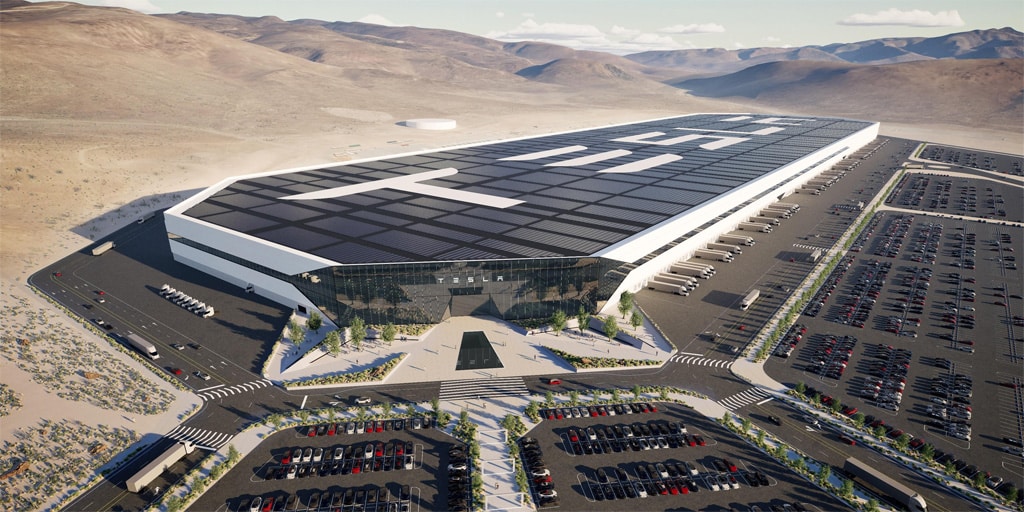
Tesla factory. Pexels Image.
While both Rivian and Tesla only build pure electric vehicles, their underlying business models are profoundly different. Tesla functions as a mass-market tech, energy, and AI ecosystem, whereas Rivian is positioned as a premium, adventure-focused lifestyle brand with a strong enterprise commercial arm.
Tesla’s master plan has always been about extreme volume and vertical integration. It targets mass-market dominance through vehicles like the Model 3 and Model Y, alongside a highly automated, hyper-efficient global factory network (Gigafactories). Its consumer brand emphasizes sleek, minimalist tech and ultimate utility.
Rivian targets the “outdoor adventure” and luxury utility niche. Its flagship consumer vehicles (R1T truck and R1S SUV) are heavy, rugged, premium-tier products. While it is moving down-market with its mid-sized R2 platform, Rivian remains firmly rooted in the lifestyle segment, building vehicles meant for off-roading and gear-heavy road trips.
While Tesla and Rivian take different strategic paths, both double down on R&D to anchor their positions as global innovation leaders. Below, we break down their R&D profiles, pitting total expenditures against crucial benchmarks like R&D-to-revenue and R&D-to-operating-expense ratios.
Let’s dive in!
For other key statistics of Rivian and Tesla, you may find more resources on these pages: Rivian key stats and Tesla key stats.
Please use the table of contents to navigate this page.
Table Of Contents
Definitions And Overview
Insight & Summary of Observed Trends
Z1. Insight & Summary of Rivian and Tesla’s R&D Comparison
R&D Statistics
Rivian vs Tesla
A1. R&D Spending
A2. R&D Growth
A3. R&D to Revenue Ratio
A4. R&D to Gross Profit Ratio
A5. R&D to OpEx Ratio
A6. R&D attributable to SBC
Reference, Credits, and Disclosure
S1. References and Credits
S2. Disclosure
Definitions
To help readers understand the content better, the following terms and glossaries have been provided.
R&D Expense: In the automotive industry, Research and Development (R&D) spending represents the total capital an automaker invests to design, engineer, and test new technologies and vehicle platforms before they ever hit the assembly line. Unlike traditional factory floor expenses, R&D is a forward-looking investment aimed at securing a company’s future market competitiveness and regulatory compliance.
The target areas for automotive R&D spending have shifted dramatically away from standard mechanical engineering. Today, the vast majority of capital is poured into three core pillars:
-
Electrification & Battery Chemistry: Developing denser, cheaper battery cells, solid-state technology, and high-efficiency electric powertrains.
-
Software-Defined Vehicles (SDVs): Building proprietary operating systems to handle over-the-air updates, advanced infotainment, and connected vehicle services.
-
Autonomous Driving & AI: Engineering advanced driver-assistance systems (ADAS), training machine learning models for computer vision, and integrating complex radar, camera, and Lidar hardware stacks.
Because vehicles are highly regulated, safety-critical machines, automotive R&D requires immense scale and a long horizon. It routinely takes years of rigorous crash-testing, aerodynamic modeling, and software validation before a newly developed platform yields a single dollar of commercial revenue, making R&D spending one of the most significant and scrutinized fixed costs on an automaker’s financial statement.
Insight & Summary of Rivian and Tesla’s R&D Comparison
The following analysis consolidates the trends observed across Rivian and Tesla in R&D comparison, consisting of R&D spending, growth, and several ratios for the 2019–2025 period.
-
R&D Spending: Scale Gap Reflects Maturity Gap Tesla outspends Rivian by approximately 2.8x in absolute R&D dollars — $6,411M (FY2025) versus $1,668M — with the FY2023–FY2025 averages of $4,973M (Tesla) and $1,759M (Rivian) reflecting Tesla’s position as a mature, multi-product automaker (vehicles, energy storage, FSD software, robotics) versus Rivian’s earlier-stage, single-platform-family operation. Tesla’s R&D has grown consistently in every year of the dataset except none — from $1,343M (FY2019) to $6,411M (FY2025), a 4.8x increase — while Rivian’s R&D peaked at $1,995M (FY2023) before declining in FY2024 (-19.1%) and only modestly recovering in FY2025 (+3.4%).
The FY2023–FY2025 average growth rates — Tesla at +28.2% versus Rivian at -4.4% — reveal starkly divergent capital allocation trajectories: Tesla is accelerating R&D investment (likely reflecting FSD/Optimus/AI compute investment) while Rivian has been retrenching, consistent with the broader cost discipline reflected in its FY2023 capex pullback discussed in the prior analysis.
-
R&D to Revenue: A Function of Business Maturity, Not Necessarily Investment Quality Rivian’s R&D-to-revenue ratio of 36.2% (FY2023–FY2025 average) dwarfs Tesla’s 5.2% — but this gap says more about revenue scale than R&D investment intensity in absolute terms. Rivian’s revenue base ($4,930M FY2023–FY2025 average per the prior analysis) is approximately 1/14th of Tesla’s, so even Rivian’s smaller absolute R&D spend represents a much larger share of its modest revenue.
Tesla’s declining-then-rising ratio — from 4.1% (FY2023) to 6.8% (FY2025) — reflects Tesla’s R&D reacceleration outpacing its revenue growth in the most recent year, a potentially important signal that Tesla is entering a new investment cycle (likely AI/robotics/FSD-related) ahead of corresponding revenue contribution. Rivian’s declining ratio (45.0% → 31.0%) is a function of both moderating R&D spend and growing revenue — a constructive trend if it continues, suggesting R&D investment intensity is normalising as the company scales.
-
R&D to Gross Profit: The Most Analytically Important Divergence This is where the comparison becomes most revealing. Tesla’s R&D-to-gross-profit ratio has been consistently positive and moderate throughout the dataset — 14.7% (FY2022) to 37.5% (FY2025), with a FY2023–FY2025 average of 28.7% — indicating Tesla comfortably funds its R&D programme from healthy, growing gross profit. Rivian’s ratio, by contrast, has been extraordinarily volatile and predominantly negative: -397.8% (FY2021), -62.2% (FY2022), -98.3% (FY2023), -134.4% (FY2024), before swinging to +1,158.3% (FY2025).
These negative ratios directly reflect Rivian’s negative gross profit during FY2021–FY2024 (consistent with the prior gross margin analysis showing consolidated gross losses through FY2024). The FY2025 ratio of +1,158.3% is a mathematical artefact of Rivian’s gross profit turning only marginally positive ($144M) against a still-substantial R&D spend ($1,668M) — meaning R&D now represents more than 11x Rivian’s entire gross profit. This metric will normalise meaningfully as Rivian’s gross profit scales, but the FY2025 reading underscores how thin Rivian’s profitability cushion remains relative to its R&D commitment.
-
R&D to OpEx: Near-Parity Despite Vastly Different Scale Both companies allocate a similar share of total operating expenditure to R&D: Rivian’s FY2023–FY2025 average of 48.2% versus Tesla’s 46.5% — within 2 percentage points of each other. This near-parity, despite the 2.8x absolute spending gap, indicates that both companies structurally prioritise R&D as the dominant component of operating expense relative to SG&A and other opex categories — a hallmark of technology-intensive automotive manufacturers as opposed to traditional legacy OEMs, where R&D typically represents a smaller share of total opex. Tesla’s ratio has expanded from 32.5% (FY2019) to 50.3% (FY2025), confirming R&D’s growing dominance of Tesla’s cost structure as the company scales its AI and autonomy investments.
-
R&D Attributable to SBC: Comparable Equity Compensation Intensity Both companies show broadly comparable shares of R&D expense attributable to share-based compensation: Rivian’s FY2023–FY2025 average of 20.4% versus Tesla’s 18.8%. This similarity is notable given the scale difference — both companies rely on substantial equity compensation to attract and retain engineering talent in the competitive EV and autonomous driving talent markets. Tesla’s SBC share has been gradually rising (17.4% FY2022 → 20.8% FY2025), while Rivian’s has been roughly stable with modest volatility (20.5% → 22.3% → 18.3%).
-
Structural Takeaway: The Rivian-Tesla R&D comparison illustrates two companies at fundamentally different stages of the same technology cycle. Tesla, now generating substantial gross profit, can fund an accelerating R&D programme (+28.2% average growth) from internally generated cash, with R&D representing a comfortable and stable 5–7% of revenue and 15–38% of gross profit — a sustainable, scaling investment posture. Rivian, still working toward consistent gross profitability, has been forced into R&D discipline (-4.4% average growth, including an outright FY2024 cut) even as its R&D-to-gross-profit ratio remains structurally stretched, reflecting the company’s pre-scale financial position.
Looking forward, Tesla’s R&D trajectory will likely continue accelerating as the company invests in Full Self-Driving, Optimus robotics, and AI compute infrastructure — areas requiring substantial and sustained R&D commitment regardless of near-term automotive revenue cyclicality. Rivian’s R&D path is more contingent: if the company’s gross margin recovery (discussed in the prior analysis) continues and R2 platform revenue materialises at scale, Rivian should be able to resume R&D growth from a stronger funding position by FY2026–FY2027.
Until then, Rivian’s R&D spending will likely remain capital-constrained and prioritised toward R2 platform completion and Georgia facility-related engineering rather than the broader autonomy and robotics ambitions that increasingly differentiate Tesla’s R&D programme. The R&D-to-gross-profit ratio will be the single most important metric to monitor for Rivian going forward — a sustained normalisation toward positive, moderate levels (similar to Tesla’s 15–35% range) would signal that Rivian has achieved the self-funding capacity needed to support its next phase of product development without continued reliance on external capital.
The table below combines all key R&D comparison metrics between Rivian and Tesla into a single view for the latest three fiscal years.
Rivian vs Tesla: R&D Comparison — Averages (FY2023–FY2025)
| Metric | Rivian | Tesla |
|---|---|---|
| R&D Spending ($M) | $1,759 | $4,973 |
| R&D Growth (%) | -4.4% | 28.2% |
| R&D to Revenue (%) | 36.2% | 5.2% |
| R&D to Gross Profit (%) | 308.5% | 28.7% |
| R&D to OpEx (%) | 48.2% | 46.5% |
| R&D Attributable to SBC (%) | 20.4% | 18.8% |
Rivian vs Tesla: Research And Development Expenses
More information about R&D expense is available here: R&D expense.
Rivian vs Tesla: R&D Spending ($M) — Average (FY2023–FY2025)
| Metric | Rivian | Tesla |
|---|---|---|
| R&D Spending ($M) | $1,759 | $4,973 |
Rivian vs Tesla: R&D Spending Growth
More information about R&D expense is available here: R&D expense.
Rivian vs Tesla: R&D Growth (%) — Average (FY2023–FY2025)
| Metric | Rivian | Tesla |
|---|---|---|
| R&D Growth (%) | -4.4% | 28.2% |
Rivian vs Tesla: R&D to Revenue Ratio
More information about R&D expense is available here: R&D expense.
Rivian vs Tesla: R&D to Revenue (%) — Average (FY2023–FY2025)
| Metric | Rivian | Tesla |
|---|---|---|
| R&D to Revenue (%) | 36.2% | 5.2% |
Rivian vs Tesla: R&D to Gross Profit Ratio
More information about R&D expense is available here: R&D expense.
Rivian vs Tesla: R&D to Gross Profit (%) — Average (FY2023–FY2025)
| Metric | Rivian | Tesla |
|---|---|---|
| R&D to Gross Profit (%) | 308.5% | 28.7% |
Rivian vs Tesla: R&D to Total Operating Expenses Ratio
More information about R&D expense is available here: R&D expense.
Rivian vs Tesla: R&D to OpEx (%) — Average (FY2023–FY2025)
| Metric | Rivian | Tesla |
|---|---|---|
| R&D to OpEx (%) | 48.2% | 46.5% |
Rivian vs Tesla: R&D attributable to Stock-Based Compensation
More information about R&D expense is available here: R&D expense.
Rivian vs Tesla: R&D Attributable to SBC (%) — Average (FY2023–FY2025)
| Metric | Rivian | Tesla |
|---|---|---|
| R&D Attributable to SBC (%) | 20.4% | 18.8% |
References and Credits
1. All financial figures presented were obtained and referenced from the companies’ respective annual and quarterly reports published on the following investor relations pages:
– Tesla Investor Relations
– Rivian Investor Relations
2. Pexels Images.
Back To Table Of Contents
Disclosure
We may use artificial intelligence (AI) tools to assist us in writing some of the text in this article. However, the data is directly obtained from original sources (usually the quarterly and annual reports) and meticulously cross-checked by our editors multiple times to ensure its accuracy and reliability.
If you find the information in this article helpful, please consider sharing it on social media. Additionally, providing a link back to this article from any website can help us create more content like this in the future.
Thank you for your support and engagement! Your involvement helps us continue to provide high-quality, reliable content.