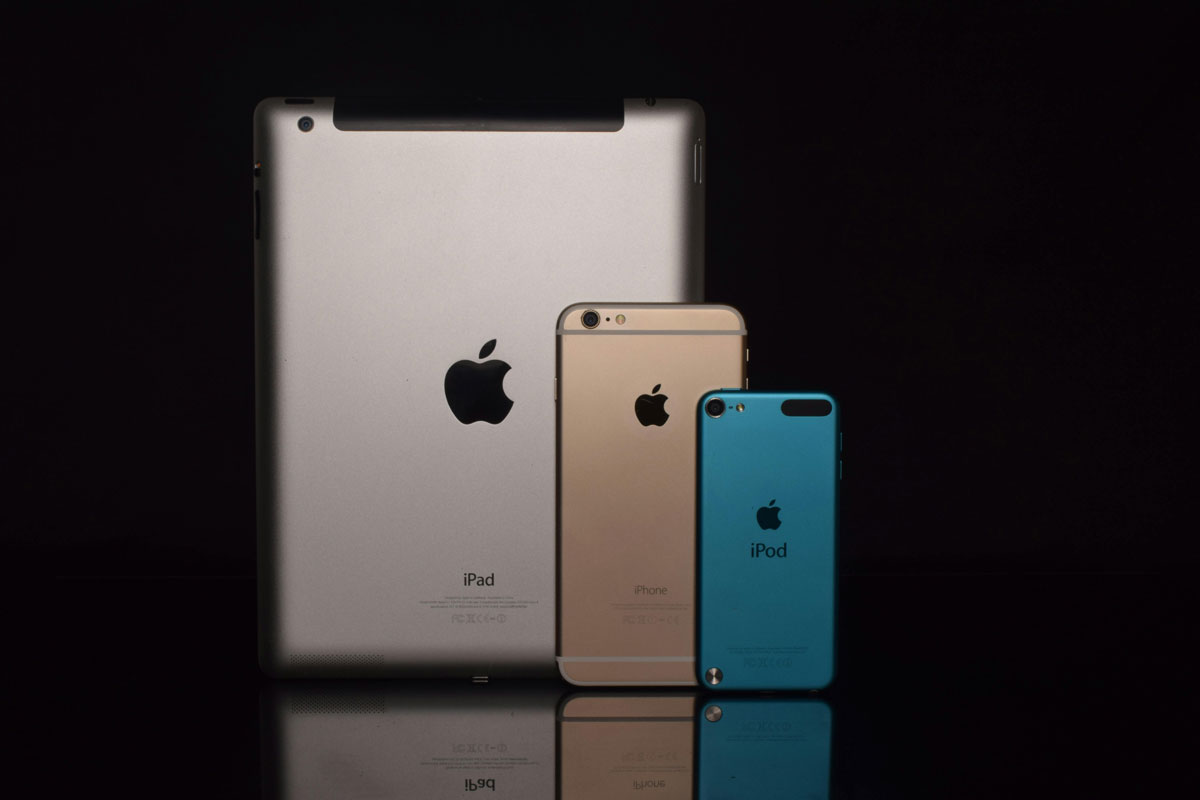
Apple’s products. Pexels Images.
This article compares the research and development (R&D) spending of Apple and Alphabet (formerly Google). Apple and Alphabet command the global technology landscape through fundamentally opposing business models.
Apple operates as a premium consumer hardware ecosystem, monetizing closed platforms and high-margin services. Conversely, Alphabet functions primarily as an advertising and data-monetization engine, leveraging ubiquitous, platform-agnostic software to drive volume alongside a rapidly expanding enterprise cloud division.
As both companies pivot aggressively toward artificial intelligence, their capital allocations reflect these divergent models. Alphabet is deploying massive capital expenditures—investing heavily in data centers and compute power—to dominate enterprise AI and cloud architecture. Meanwhile, Apple focuses its innovation on seamless, on-device AI integration to stimulate hardware upgrade cycles and defend the lifetime value of its consumer base.
In this article, we will explore the R&D expenses of Apple and Alphabet, comparing how each company allocates resources to maintain its technological edge and leadership in the respective industry.
Investors looking for key statistics of Apple and Alphabet may find more resources on these pages:
Apple Revenue and Expenses
- Apple revenue breakdown by region,
- Apple revenue breakdown by country,
- Apple revenue breakdown by product line,
- Apple operating expenses breakdown analysis,
Other R&D Statistics
- Apple vs Samsung: R&D budget, growth, and ratio to revenue and profit,
- Apple vs Microsoft: R&D budget, growth, and ratio to revenue and profit,
Please use the table of contents to navigate this page.
Table Of Contents
Definitions And Overview
Insight & Summary of Observed Trends
Z1. Insight & Summary of Apple and Alphabet’s R&D Comparison
Apple vs Alphabet: R&D Statistics
R&D Spending
R&D Ratios
A2. R&D To Revenue Ratio
A3. R&D To Gross Profit Ratio
A4. R&D To Operating Expenses (OpEx) Ratio
Reference, Credits, and Disclosure
S1. References and Credits
S2. Disclosure
Definitions
To help readers understand the content better, the following terms and glossaries have been provided.
R&D To Revenue Ratio: The R&D to revenue ratio is a financial metric measuring the proportion of a company’s revenue that is spent on research and development (R&D).
It is calculated by dividing the total R&D expenditures by the total revenue, usually expressed as a percentage. This ratio helps investors and analysts understand how much a company is investing in innovation and future growth relative to its sales.
The formula for the R&D to revenue ratio is:
\[\text{R&D to Revenue Ratio} = \left( \frac{\text{R&D Expenditures}}{\text{Total Revenue}} \right) \times 100\%\]
A higher R&D to revenue ratio indicates a stronger commitment to innovation and development, which can be crucial for long-term growth and competitiveness.
R&D To Gross Profit Ratio: The R&D to gross profit ratio is a financial metric measuring the proportion of a company’s gross profit that is spent on research and development (R&D).
This ratio helps investors and analysts evaluate how much of a company’s gross profit is being reinvested into innovation and future growth.
The formula for the R&D to gross profit ratio is:
\[\text{R&D to Gross Profit Ratio} = \left( \frac{\text{R&D Expenditures}}{\text{Gross Profit}} \right) \times 100\%\]
A higher R&D to gross profit ratio indicates a greater investment in innovation relative to the company’s profitability, which can be a sign of a commitment to long-term growth and competitiveness.
R&D To Operating Expenses Ratio: The R&D to operating expenses ratio is a financial metric measuring the proportion of a company’s operating expenses that are spent on research and development (R&D).
This ratio helps evaluate how much of the company’s total expenses are dedicated to innovation and future growth efforts.
The formula for the R&D to operating expenses ratio is:
\[\text{R&D to Operating Expenses Ratio} = \left( \frac{\text{R&D Expenditures}}{\text{Total Operating Expenses}} \right) \times 100\%\]
A higher R&D to operating expenses ratio indicates a greater commitment to innovation relative to the company’s overall spending, which can be a positive indicator of future growth potential. Comparing this ratio with industry peers can provide additional insights into a company’s investment in research and development.
Insight & Summary of Apple and Alphabet’s R&D Comparison
The following analysis consolidates the trends observed across Apple and Alphabet in R&D comparison, consisting of R&D spending, growth, and several ratios for the 2018–2025 period.
-
Alphabet significantly outpaces Apple in absolute R&D investment, scaling its average expenditure to $51,947 million over the last three periods, driven by a faster 15.8% average growth rate compared to Apple’s $31,945 million and 9.7% growth.
-
This reflects Alphabet’s intensive capital requirements for scaling AI infrastructure, developing foundational models, and maintaining broad software platforms.
-
Consequently, Alphabet inherently consumes a larger share of its revenue (14.7%) and gross profit (25.2%) for research than Apple’s highly efficient, hardware-centric ecosystem (8.0% and 17.6%, respectively).
-
Despite these divergent business models, both companies exhibit remarkable strategic alignment in their operating expense structures. Apple directs 54.9% of its total OpEx to R&D, while Alphabet closely trails at 53.2%.
-
This demonstrates that both organizations maintain exceptionally lean administrative and marketing profiles, deliberately prioritizing product innovation and long-term technological leadership over overhead.
The table below combines Apple and Alphabet’s R&D metrics into a single view for the latest three fiscal years.
Apple vs. Alphabet: Consolidated R&D Metrics 3-Year Averages (FY2023–2025)
| Metric | Apple | Alphabet |
|---|---|---|
| R&D Spending ($ Millions) | $31,945 | $51,947 |
| R&D Growth (%) | 9.7% | 15.8% |
| R&D to Revenue Ratio (%) | 8.0% | 14.7% |
| R&D to OpEx Ratio (%) | 54.9% | 53.2% |
| R&D to Gross Profit Ratio (%) | 17.6% | 25.2% |
Apple vs Alphabet: R&D Spending and Growth
R&D Spending & Growth 3-Year Averages (FY2023–2025)
| Metric | Apple | Alphabet |
|---|---|---|
| R&D Spending ($ Millions) | $31,945 | $51,947 |
| R&D Growth (%) | 9.7% | 15.8% |
Apple vs Alphabet: R&D to Revenue Ratio
You can find the definition of the R&D to revenue ratio here: R&D To Revenue Ratio.
R&D to Revenue Ratio 3-Year Averages (FY2023–2025)
| Metric | Apple | Alphabet |
|---|---|---|
| R&D to Revenue Ratio (%) | 8.0% | 14.7% |
Apple vs Alphabet: R&D to Gross Profit Ratio
You can find the definition of the R&D to gross profit ratio here: R&D To Gross Profit Ratio.
R&D to Gross Profit Ratio 3-Year Averages (FY2023–2025)
| Metric | Apple | Alphabet |
|---|---|---|
| R&D to Gross Profit Ratio (%) | 17.6% | 25.2% |
Apple vs Alphabet: R&D to Operating Expenses Ratio
You can find the definition of the R&D to OPEX ratio here: R&D To Operating Expenses Ratio.
R&D to OpEx Ratio 3-Year Averages (FY2023–2025)
| Metric | Apple | Alphabet |
|---|---|---|
| R&D to OpEx Ratio (%) | 54.9% | 53.2% |
References and Credits
1. All financial figures presented in this article were obtained and referenced from Apple and Alphabet’s annual reports published on the company’s investors relations page: Apple Investor Relations and Alphabet Investor Relations.
2. Pexels Images.
Disclosure
References and examples such as tables, charts, and diagrams are constantly reviewed to avoid errors, but we cannot warrant the total correctness of all content.
The content in this article is for informational purposes only and is neither a recommendation nor a piece of financial advice to purchase a stock.
If you find the information in this article helpful, please consider sharing it on social media and also provide a link back to this article from any website so that more articles like this one can be created in the future.
Thank you!