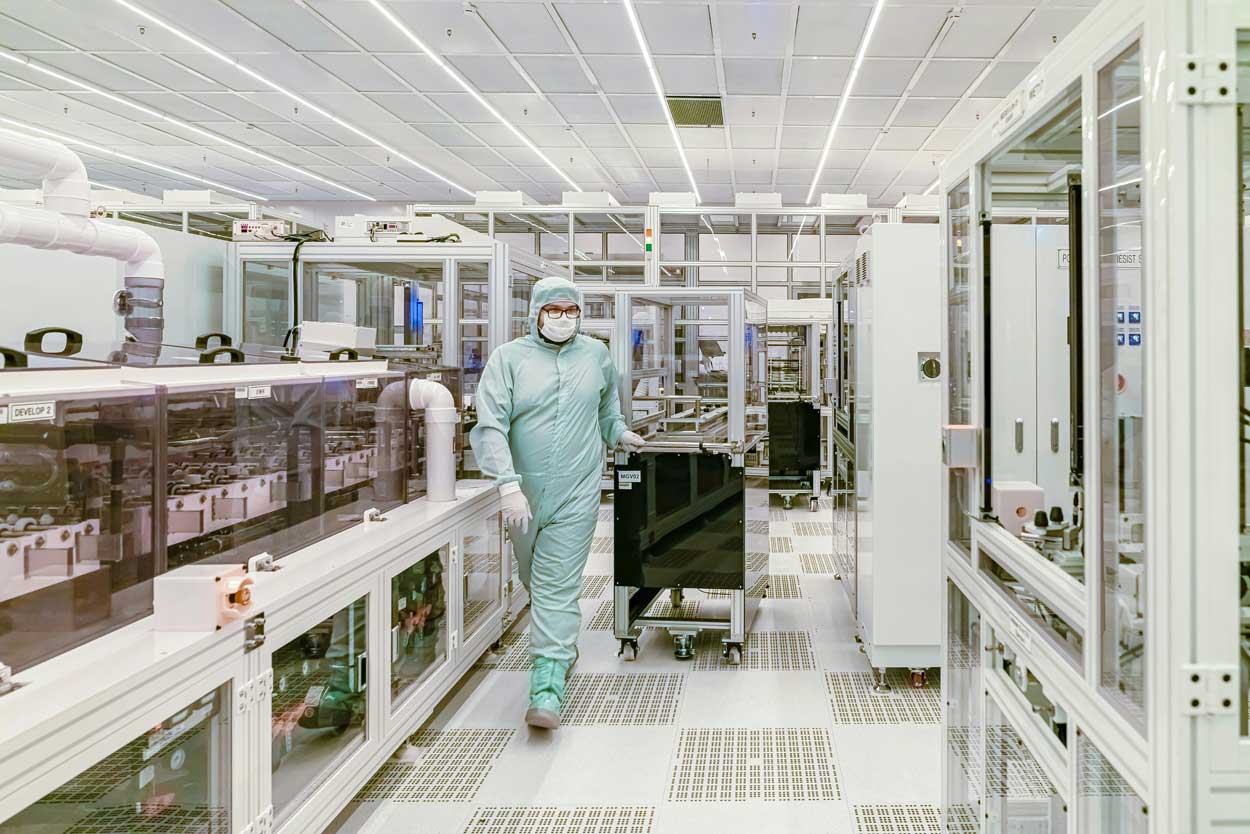
Clean room. Pexels Images.
This article explores the research and development (R&D) spending of TSMC and Samsung Electronics.
TSMC operates as a pure-play foundry, meaning it manufactures semiconductors for other companies. Notably, TSMC produces chips for clients such as Apple, AMD, and Nvidia. Unlike some of its competitors, TSMC does not design its own chips, focusing instead on the manufacturing process to ensure the highest quality for its customers.
Samsung, on the other hand, has a more diversified business model. It operates a foundry business similar to TSMC but also designs and manufactures its own semiconductor products. Additionally, Samsung is involved in various other segments, including consumer electronics, IT & mobile communications, and device solutions.
Despite their different business models, both companies are at the forefront of semiconductor technology, investing heavily in research and development to stay ahead in the industry. They have pioneered advanced manufacturing processes, such as 7nm, 5nm, and 3nm nodes.
In this article, we delve into the R&D expenditures of both firms, comparing how each company allocates resources to maintain its technological edge and leadership in the semiconductor industry.
Let’s look at the R&D numbers!
For other key statistics of TSMC, you may find more information on this page: TSMC key statistics.
Please use the table of contents to navigate this page.
Table Of Contents
Definitions And Overview
Insight & Summary of Observed Trends
Z1. Insight & Summary of TSMC and Samsung’s R&D Comparison
R&D Statistics
TSMC vs Samsung
A1. R&D Spending & Growth
A2. R&D to Revenue Ratio
A3. R&D to Gross Profit Ratio
A4. R&D to OpEx Ratio
Reference, Credits, and Disclosure
S1. References and Credits
S2. Disclosure
Definitions
To help readers understand the content better, the following terms and glossaries have been provided.
Currency Conversion: TSMC and Samsung presented their financial results in their native currencies, specifically the New Taiwan Dollar (TWD) for TSMC and the Korean Won (KRW) for Samsung.
The respective companies handled the conversion of these currencies to US dollars at the time of their earnings presentations, rather than the editors.
The exchange between the USD and the New Taiwan Dollar and South Korean Won are as follow:
1 USD = 31.51 TWD
1 USD = 1,488.73 KRW
R&D To Revenue Ratio: The R&D to revenue ratio is a financial metric measuring the proportion of a company’s revenue that is spent on research and development (R&D).
It is calculated by dividing the total R&D expenditures by the total revenue, usually expressed as a percentage. This ratio helps investors and analysts understand how much a company is investing in innovation and future growth relative to its sales.
The formula for the R&D to revenue ratio is:
\[\text{R&D to Revenue Ratio} = \left( \frac{\text{R&D Expenditures}}{\text{Total Revenue}} \right) \times 100\%\]
A higher R&D to revenue ratio indicates a stronger commitment to innovation and development, which can be crucial for long-term growth and competitiveness.
R&D To Gross Profit Ratio: The R&D to gross profit ratio is a financial metric measuring the proportion of a company’s gross profit that is spent on research and development (R&D).
This ratio helps investors and analysts evaluate how much of a company’s gross profit is being reinvested into innovation and future growth.
The formula for the R&D to gross profit ratio is:
\[\text{R&D to Gross Profit Ratio} = \left( \frac{\text{R&D Expenditures}}{\text{Gross Profit}} \right) \times 100\%\]
A higher R&D to gross profit ratio indicates a greater investment in innovation relative to the company’s profitability, which can be a sign of a commitment to long-term growth and competitiveness.
R&D To Operating Expenses Ratio: The R&D to operating expenses ratio is a financial metric measuring the proportion of a company’s operating expenses that are spent on research and development (R&D).
This ratio helps evaluate how much of the company’s total expenses are dedicated to innovation and future growth efforts.
The formula for the R&D to operating expenses ratio is:
\[\text{R&D to Operating Expenses Ratio} = \left( \frac{\text{R&D Expenditures}}{\text{Total Operating Expenses}} \right) \times 100\%\]
A higher R&D to operating expenses ratio indicates a greater commitment to innovation relative to the company’s overall spending, which can be a positive indicator of future growth potential. Comparing this ratio with industry peers can provide additional insights into a company’s investment in research and development.
FAQs
To help readers understand the content better, the following FAQs have been provided.
Who Is Winning The R&D Race?
The race for research and development (R&D) in the semiconductor industry is fiercely competitive, with both TSMC (Taiwan Semiconductor Manufacturing Company) and Samsung Electronics making significant strides.
TSMC has consistently invested heavily in R&D to maintain its technological edge, focusing on advanced manufacturing processes such as 3nm and 2nm nodes. This aggressive pursuit of cutting-edge technology has positioned TSMC as a leader in the semiconductor industry, allowing it to pioneer several advancements, including the 7nm FinFET and 5nm processes essential for high-performance and energy-efficient chips.
Similarly, Samsung Electronics allocates substantial resources to R&D, particularly in memory chips and advanced nodes. Samsung’s investment in gate-all-around (GAA) technology for 3nm chips exemplifies its commitment to innovation. The company’s significant progress in semiconductor technology, particularly in memory and logic chips, has made it a formidable competitor in the industry. Samsung’s 3nm GAA technology promises improved performance and power efficiency over traditional FinFET designs, highlighting its focus on technological advancements.
Both TSMC and Samsung are capitalizing on the growing demand for generative AI chips and data center build-outs, segments expected to drive significant growth in the semiconductor industry. Their extensive R&D efforts ensure they remain competitive in the rapidly evolving market, maintaining strong global market presence and key partnerships. TSMC and Samsung’s ongoing commitment to innovation underscores their competitiveness and critical role in driving the industry’s advancements.
Declaring a definitive winner in the R&D race is challenging as both companies are leading the charge with substantial investments and technological advancements. TSMC’s focus on cutting-edge manufacturing processes and Samsung’s progress in memory and logic chips positions both companies at the forefront of semiconductor innovation. Their respective strategies and substantial R&D efforts will continue to shape the future of the semiconductor industry.
Insight & Summary of TSMC and Samsung’s R&D Comparison
The following analysis consolidates the trends observed across TSMC and Samsung in R&D comparison, consisting of R&D spending, growth, and several ratios for the 2018–2025 period.
-
Samsung outspends TSMC on R&D by approximately 3.7x in absolute dollar terms — a gap that reflects the fundamental difference in business scope. Samsung’s R&D spending grew from $16.95B in 2018 to $26.54B in 2025, with a 3-year average of $24.6B. TSMC’s R&D grew from $2.81B in 2018 to $7.86B in 2025, with a 3-year average of $6.7B. The absolute gap is enormous and structurally explained by Samsung’s need to fund R&D across memory (DRAM, NAND), logic semiconductors, display panels, smartphones, consumer electronics, and its foundry business simultaneously. TSMC, as a pure-play foundry, concentrates R&D exclusively on semiconductor process technology — N3, N2, A16 nodes, advanced packaging, and CoWoS. The narrowness of TSMC’s mandate allows it to achieve industry-leading outcomes with a fraction of Samsung’s total R&D budget.
-
As a share of revenue, however, Samsung now spends more than TSMC — and the gap has widened significantly. TSMC’s R&D-to-revenue ratio has declined from 8.3% in 2018 to 6.5% in 2025, with a 3-year average of 7.3%. Samsung’s ratio has increased from 7.7% in 2018 to 11.3% in 2025, with a 3-year average of 11.3%. The inversion is striking: in 2018 TSMC and Samsung had nearly identical R&D intensity (8.3% vs 7.7%), but by 2025 Samsung is spending 480 basis points more of revenue on R&D. This divergence is primarily driven by Samsung’s revenue declining (denominator effect) while its R&D budget grew, combined with TSMC’s revenue surging much faster than its R&D budget. Paradoxically, the company with the better technology outcomes (TSMC) is spending less of its revenue on R&D than the company struggling to catch up (Samsung).
-
The R&D-to-gross-profit ratio reveals the true cost of Samsung’s R&D relative to its ability to fund it. TSMC’s R&D-to-gross-profit ratio has declined from 17.3% (2018) to 10.8% (2025), with a 3-year average of 13.0% — meaning TSMC is spending approximately 13 cents of every gross profit dollar on R&D. Samsung’s ratio surged from 16.7% (2018) to 36.1% (2023, driven by the memory crash), settling at 28.7% (2025), with a 3-year average of 31.8%. Samsung is spending nearly one-third of its gross profit on R&D — a level that reflects both ambitious spending and the pressure of compressed margins in cyclical memory years. For a company with Samsung’s earnings volatility, maintaining $21–27B of annual R&D through down cycles requires significant capital discipline and is the primary reason Samsung’s free cash flow has been under pressure.
-
TSMC’s R&D-to-OpEx ratio is the most distinctive metric — and the one most revealing of its unique operating structure. TSMC’s R&D-to-OpEx ratio has averaged 70.3% over the latest three years, ranging from 67.8% to 71.9%. This extremely high ratio — meaning R&D accounts for approximately 70% of all operating expenses — reflects TSMC’s deliberate decision to minimise all non-R&D operating costs (sales, marketing, G&A) and concentrate spending almost entirely on process technology development. Samsung’s ratio averaged 41.8% — lower, but still indicating that R&D is the dominant component of its operating expense structure as well. The contrast in ratios (70.3% vs 41.8%) shows that TSMC is an even purer R&D-to-manufacturing translation machine than Samsung — every operational dollar that isn’t a direct manufacturing cost goes into process technology.
-
R&D growth rates have been broadly similar, with TSMC accelerating sharply in 2025. TSMC’s 3-year average R&D growth of 14.1% slightly outpaces Samsung’s 11.4%, driven by TSMC’s aggressive FY2025 increase (+23.6% to $7.86B) — a direct response to the N2 node development acceleration and CoWoS advanced packaging capacity expansion for AI customers including NVIDIA and Apple. Samsung’s more volatile growth pattern (ranging from -2.3% in 2022 to +18.3% in 2024) reflects the cyclicality of its memory business and corporate budget flexibility. Both companies are committed to sustained R&D investment — neither has structurally cut R&D budgets even in down years — which confirms that both view process technology leadership as non-negotiable.
-
Structural Takeaway: The TSMC-Samsung R&D comparison presents two philosophically different approaches to technology investment. TSMC spends less in absolute terms, less as a share of revenue, and achieves better process technology outcomes — a model of concentrated, high-efficiency R&D. Samsung spends more across more fronts, with higher revenue intensity and gross profit burden, and has struggled to match TSMC’s foundry process technology despite the larger budget. For investors, TSMC’s declining R&D-to-revenue ratio amid accelerating revenue growth is a positive signal — the leverage on R&D investment is improving. Samsung’s rising R&D intensity in a period of margin pressure is a structural concern, though the absolute R&D commitment signals Samsung’s long-term intent to compete across all semiconductor segments.
The table below combines all key R&D comparison metrics between TSMC and Samsung into a single view for the latest three fiscal years.
TSMC vs Samsung R&D Comparison — Consolidated Averages (FY2023–2025)
| Metric | TSMC | Samsung |
|---|---|---|
| R&D Spending ($M) | 6,722 | 24,639 |
| R&D Growth (%) | 14.1% | 11.4% |
| R&D to Revenue (%) | 7.3% | 11.3% |
| R&D to Gross Profit (%) | 13.0% | 31.8% |
| R&D to OpEx (%) | 70.3% | 41.8% |
TSMC vs Samsung: R&D Spending & Growth
View data as table
TSMC vs Samsung: R&D Expense and Growth — By Year
| Fiscal Year | R&D Expense | R&D Growth | ||
|---|---|---|---|---|
| TSMC | Samsung | TSMC | Samsung | |
| 2018 | $2,806M | $16,952M | N.A. | N.A. |
| 2019 | $3,057M | $17,326M | 8.9% | 2.2% |
| 2020 | $3,899M | $17,977M | 27.5% | 3.8% |
| 2021 | $4,497M | $19,750M | 15.3% | 9.9% |
| 2022 | $5,313M | $19,300M | 18.1% | -2.3% |
| 2023 | $5,956M | $21,698M | 12.1% | 12.4% |
| 2024 | $6,355M | $25,676M | 6.7% | 18.3% |
| 2025 | $7,855M | $26,543M | 23.6% | 3.4% |
TSMC and Samsung report their financial results in their native currencies. The conversion of these currencies to USD was carried out by the respective companies, rather than the editors.
The exchange rate between the USD and the New Taiwan Dollar and South Korea Won can be found here: currency exchange.
TSMC vs Samsung R&D Spending & Growth — Average (FY2023–2025)
| Metric | TSMC | Samsung |
|---|---|---|
| R&D Spending ($M) | 6,722 | 24,639 |
| R&D Growth (%) | 14.1% | 11.4% |
TSMC vs Samsung: R&D To Revenue Ratio
View data as table
TSMC vs Samsung: R&D to Revenue Ratio — By Year
| Fiscal Year | TSMC | Samsung |
|---|---|---|
| 2018 | 8.3% | 7.7% |
| 2019 | 8.5% | 8.8% |
| 2020 | 8.2% | 9.0% |
| 2021 | 7.9% | 8.1% |
| 2022 | 7.2% | 8.2% |
| 2023 | 8.4% | 10.9% |
| 2024 | 7.1% | 11.6% |
| 2025 | 6.5% | 11.3% |
You can find the definition of the R&D to revenue ratio here: R&D To Revenue Ratio.
TSMC and Samsung report their financial results in their native currencies. The conversion of these currencies to USD was carried out by the respective companies, rather than the editors.
The exchange rate between the USD and the New Taiwan Dollar and South Korea Won can be found here: currency exchange.
TSMC vs Samsung R&D to Revenue Ratio — Average (FY2023–2025)
| Metric | TSMC | Samsung |
|---|---|---|
| R&D to Revenue (%) | 7.3% | 11.3% |
TSMC vs Samsung: R&D To Gross Profit Ratio
View data as table
TSMC vs Samsung: R&D to Gross Profit Ratio — By Year
| Fiscal Year | TSMC | Samsung |
|---|---|---|
| 2018 | 17.3% | 16.7% |
| 2019 | 18.6% | 24.3% |
| 2020 | 15.4% | 23.0% |
| 2021 | 15.2% | 20.0% |
| 2022 | 12.1% | 22.2% |
| 2023 | 15.5% | 36.1% |
| 2024 | 12.6% | 30.6% |
| 2025 | 10.8% | 28.7% |
You can find the definition of the R&D to gross profit ratio here: R&D To Gross Profit Ratio.
TSMC and Samsung report their financial results in their native currencies. The conversion of these currencies to USD was carried out by the respective companies, rather than the editors.
The exchange rate between the USD and the New Taiwan Dollar and South Korea Won can be found here: currency exchange.
TSMC vs Samsung R&D to Gross Profit Ratio — Average (FY2023–2025)
| Metric | TSMC | Samsung |
|---|---|---|
| R&D to Gross Profit (%) | 13.0% | 31.8% |
TSMC vs Samsung: R&D To Operating Expenses Ratio
View data as table
TSMC vs Samsung: R&D to OpEx Ratio — By Year
| Fiscal Year | TSMC | Samsung |
|---|---|---|
| 2018 | 76.6% | 35.5% |
| 2019 | 76.5% | 36.5% |
| 2020 | 75.5% | 37.7% |
| 2021 | 73.7% | 36.7% |
| 2022 | 72.0% | 36.2% |
| 2023 | 71.9% | 39.4% |
| 2024 | 67.8% | 42.9% |
| 2025 | 71.3% | 43.0% |
You can find the definition of the R&D to OPEX ratio here: R&D To Operating Expenses Ratio.
TSMC and Samsung report their financial results in their native currencies. The conversion of these currencies to USD was carried out by the respective companies, rather than the editors.
The exchange rate between the USD and the New Taiwan Dollar and South Korea Won can be found here: currency exchange.
TSMC vs Samsung R&D to OpEx Ratio — Average (FY2023–2025)
| Metric | TSMC | Samsung |
|---|---|---|
| R&D to OpEx (%) | 70.3% | 41.8% |
References and Credits
1. All financial figures presented were obtained and referenced from TSMC’s and Samsung annual reports published on the companies’ investor relations pages: TSMC Annual Reports and Samsung Investor Relations.
2. Pexels Images.
Back To Table Of Contents
Disclosure
We may use artificial intelligence (AI) tools to assist us in writing some of the text in this article. However, the data is directly obtained from original sources (usually the quarterly and annual reports) and meticulously cross-checked by our editors multiple times to ensure its accuracy and reliability.
If you find the information in this article helpful, please consider sharing it on social media. Additionally, providing a link back to this article from any website can help us create more content like this in the future.
Thank you for your support and engagement! Your involvement helps us continue to provide high-quality, reliable content.