
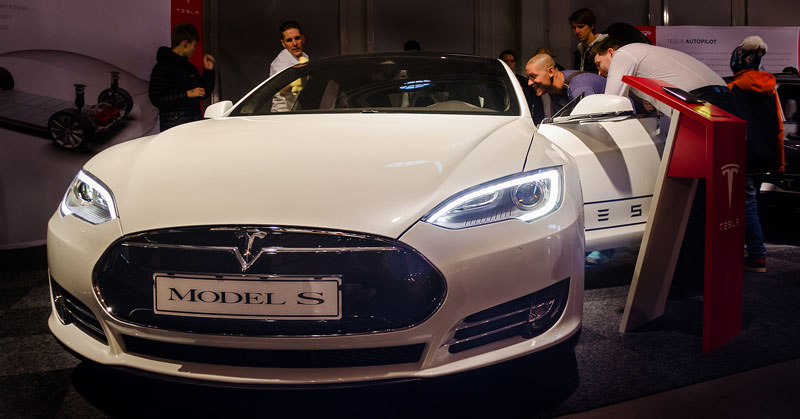
Tesla Model S at a car show. Source: Flickr
This article explores the breakdown of Tesla’s revenue and profit margin by segment. Tesla’s segments primarily consist of automotive and energy.
Do note that the automotive segment results presented here include the “services and other” and regulatory credits category.
Let’s check them out!
For other key statistics of Tesla, you may find more resources on this page: Tesla key stats.
Please use the table of contents to navigate this page.
Table Of Contents
Definitions And Overview
Insight & Summary of Observed Trends
Z1. Insight & Summary of Tesla’s Revenue and Profit Margin By Segment
Revenue By Segment
A1. Automotive, Energy, and Consolidated – Revenue Numbers
A2. Automotive, Energy, and Consolidated – Revenue Mix
A3. Automotive, Energy, and Consolidated – Revenue Growth
Profit Margin By Segment
B1. Automotive, Energy, and Consolidated – Gross Profit
B2. Automotive, Energy, and Consolidated – Gross Margin
Reference, Credits, and Disclosure
S1. References and Credits
S2. Disclosure
Definitions
To help readers understand the content better, the following terms and glossaries have been provided.
Automotive Segment: Tesla’s automotive segment refers to the company’s core business of designing, developing, manufacturing, selling, and leasing high-performance fully electric vehicles.
This segment also includes the sales of automotive regulatory credits. In addition, Tesla’s automotive segment also includes services and other offerings such as the sales of used vehicles, non-warranty after-sales vehicle services, body shops and parts, paid supercharging, vehicle insurance revenue, and retail merchandise.
Energy Generation And Storage Segment: Tesla’s energy segment includes the design, manufacture, installation, sales and leasing of solar energy generation and energy storage products and related services and sales of solar energy systems incentives.
In particular, Tesla offers solar panels, solar roofs, and energy storage solutions like the Powerwall and Powerpack. These products aim to help homeowners, businesses, and utilities transition to clean energy and reduce reliance on fossil fuels.
Additionally, Tesla provides related services such as installation, maintenance, and support to ensure customers get the most out of their solar and storage systems.
Insight & Summary of Tesla’s Revenue and Profit Margin By Segment
The following analysis consolidates the trends observed across Tesla revenue and profit margin by segment for the 2015–2025 period.
-
The Automotive segment remains dominant but is in structural retreat as a share of total revenue. Automotive revenue peaked at $90.7B in 2023 and has since declined for two consecutive years — to $87.6B in 2024 and $82.1B in 2025 — a -6.3% contraction in the most recent year. Its revenue share has compressed from a high of 95.2% in 2022 to 86.5% in 2025, the lowest in the dataset. The 3-year average growth of just 2.4% (dragged negative by 2024–2025 declines) stands in sharp contrast to the explosive trajectory of prior years (72.8% in 2021, 52.0% in 2022). This deceleration reflects a combination of deliberate price cuts to defend volume, intensifying EV competition, and a maturing product lineup — structural headwinds that pricing strategy alone cannot resolve.
-
The Energy segment is emerging as a genuine second growth engine, growing faster and becoming more profitable simultaneously. Energy revenue has compounded from $15M in 2015 to $12.8B in 2025 — an 850x increase — with a 3-year average growth rate of 49.4% and a 2025 growth rate of 26.6% even against a high base. Its revenue share has grown from near-zero to 13.5% in 2025, the highest in the dataset. Crucially, the Energy segment has achieved this with dramatically improving profitability: gross margin expanded from 0.9% in 2020 and -4.6% in 2021 to 29.8% in 2025 — now the highest-margin segment Tesla operates. The 3-year average gross margin of 25.0% for Energy now meaningfully exceeds Automotive’s 17.1%.
-
Gross profit dynamics reveal a structural inversion underway. In 2023, Automotive contributed $16.5B of gross profit (93.5% of the total) against Energy’s $1.1B. By 2025, Automotive has declined to $13.3B while Energy has grown to $3.8B — a 22% Energy share of total gross profit, up from 6.5% just two years prior. On current trajectories, Energy’s contribution to total gross profit could approach or exceed one-third within the next two years. Meanwhile, total gross profit has remained nearly flat across all three years ($17.7B → $17.5B → $17.1B), meaning the entire Tesla gross profit pool has been sustained only because Energy growth has offset Automotive compression. This substitution dynamic is not indefinitely sustainable if Automotive continues declining.
-
Automotive gross margin has deteriorated significantly from its 2021–2022 peak. Automotive gross margin peaked at 26.9% in 2021, a high-water mark driven by strong pricing power, favorable vehicle mix, and constrained supply. By 2025, it has compressed to 16.2% — a 10.7 percentage-point decline in four years — driven by price reductions, rising costs of capital-intensive manufacturing, and the absorption of new model launch expenses. The 3-year average of 17.1% is still respectable for a pure-play automaker but falls well short of the premium margin profile that historically justified Tesla’s valuation premium over legacy OEMs.
-
Total gross margin has stabilized modestly, rescued by Energy’s rise. Total gross margin has compressed from 25.6% in 2022 to 18.0% in 2025, but the pace of compression has slowed and the 3-year average of 18.0% appears to be finding a floor — supported by Energy’s margin accretion. This Energy-driven stabilization is a meaningful strategic development: it suggests that Tesla’s blended profitability profile is becoming less dependent on Automotive pricing assumptions and more diversified across a genuinely high-margin industrial business.
-
Structural Takeaway: Tesla is in a period of strategic transition that the financial data now confirms clearly. The Automotive segment, the historical engine of both revenue and profit growth, is contracting in absolute terms for the first time. The Energy segment — once a rounding error — has become a $12.8B, nearly 30%-margin business that is actively stabilizing Tesla’s total profit pool. For investors, the critical question is whether this Energy growth trajectory can scale fast enough (and Automotive can stabilize or recover) to restore overall gross profit growth — or whether the portfolio effect merely softens the pace of margin deterioration in an Automotive business that has not yet found its pricing floor.
The table below combines all key revenue metrics and profit margin into a single view for the latest three fiscal years.
Tesla Revenue & Profit by Segment — Consolidated Averages (FY2023–2025)
| Metric | Average (2023–2025) |
|---|---|
| Revenue Numbers (US$ Millions) | |
| Automotive Segment | 86,799 |
| Energy Segment | 9,631 |
| Total Revenue | 96,430 |
| Revenue Mix (%) | |
| Automotive Segment | 90.0% |
| Energy Segment | 10.0% |
| Total Revenue | 100.0% |
| Revenue Growth (%) | |
| Automotive Segment | 2.4% |
| Energy Segment | 49.4% |
| Total Revenue | 5.6% |
| Gross Profit (US$ Millions) | |
| Automotive Segment | 14,874 |
| Energy Segment | 2,528 |
| Total Gross Profit | 17,401 |
| Gross Margin (%) | |
| Automotive Segment | 17.1% |
| Energy Segment | 25.0% |
| Total Gross Margin | 18.0% |
Automotive, Energy, and Consolidated – Revenue Numbers
View data as table
Tesla Revenue by Segment — All Metrics by Fiscal Year
| Fiscal Year | Automotive Segment | Energy Segment | Total Segment |
|---|---|---|---|
| 2015 | $4,031M | $15M | $4,046M |
| 2016 | $6,819M | $181M | $7,000M |
| 2017 | $10,643M | $1,116M | $11,759M |
| 2018 | $19,906M | $1,555M | $21,461M |
| 2019 | $23,047M | $1,531M | $24,578M |
| 2020 | $29,542M | $1,994M | $31,536M |
| 2021 | $51,034M | $2,789M | $53,823M |
| 2022 | $77,553M | $3,909M | $81,462M |
| 2023 | $90,738M | $6,035M | $96,773M |
| 2024 | $87,604M | $10,086M | $97,690M |
| 2025 | $82,056M | $12,771M | $94,827M |
The definitions of Tesla’s segments are available here: Automotive and Energy.
Tesla Revenue by Segment — Average Revenue Numbers (US$ Millions) (FY2023–2025)
| Segment | Average (2023–2025) |
|---|---|
| Automotive Segment | 86,799 |
| Energy Segment | 9,631 |
| Total Revenue | 96,430 |
Automotive, Energy, and Consolidated – Revenue Mix
View data as table
Tesla Revenue Mix by Segment — All Metrics by Fiscal Year
| Fiscal Year | Automotive Segment | Energy Segment |
|---|---|---|
| 2015 | 99.6% | 0.4% |
| 2016 | 97.4% | 2.6% |
| 2017 | 90.5% | 9.5% |
| 2018 | 92.8% | 7.2% |
| 2019 | 93.8% | 6.2% |
| 2020 | 93.7% | 6.3% |
| 2021 | 94.8% | 5.2% |
| 2022 | 95.2% | 4.8% |
| 2023 | 93.8% | 6.2% |
| 2024 | 89.7% | 10.3% |
| 2025 | 86.5% | 13.5% |
The definitions of Tesla’s segments are available here: Automotive and Energy.
Tesla Revenue by Segment — Average Revenue Mix (%) (FY2023–2025)
| Segment | Average (2023–2025) |
|---|---|
| Automotive Segment | 90.0% |
| Energy Segment | 10.0% |
| Total Revenue | 100.0% |
Automotive, Energy, and Consolidated – Revenue Growth
View data as table
Tesla Revenue Growth by Segment — All Metrics by Fiscal Year
| Fiscal Year | Automotive Segment | Energy Segment | Total Segment |
|---|---|---|---|
| 2016 | 69.2% | n.a. | 73.0% |
| 2017 | 56.1% | n.a. | 68.0% |
| 2018 | 87.0% | 39.3% | 82.5% |
| 2019 | 15.8% | -1.5% | 14.5% |
| 2020 | 28.2% | 30.2% | 28.3% |
| 2021 | 72.8% | 39.9% | 70.7% |
| 2022 | 52.0% | 40.2% | 51.4% |
| 2023 | 17.0% | 54.4% | 18.8% |
| 2024 | -3.5% | 67.1% | 0.9% |
| 2025 | -6.3% | 26.6% | -2.9% |
The definitions of Tesla’s segments are available here: Automotive and Energy.
Tesla Revenue by Segment — Average Revenue Growth (%) (FY2023–2025)
| Segment | Average (2023–2025) |
|---|---|
| Automotive Segment | 2.4% |
| Energy Segment | 49.4% |
| Total Revenue | 5.6% |
Automotive, Energy, and Consolidated – Gross Profit
View data as table
Tesla Gross Profit by Segment — All Metrics by Fiscal Year
| Fiscal Year | Automotive Segment | Energy Segment | Total Segment |
|---|---|---|---|
| 2015 | $921M | $2M | $923M |
| 2016 | $1,596M | $3M | $1,599M |
| 2017 | $1,981M | $242M | $2,223M |
| 2018 | $3,852M | $190M | $4,042M |
| 2019 | $3,879M | $190M | $4,069M |
| 2020 | $6,612M | $18M | $6,630M |
| 2021 | $13,735M | -$129M | $13,606M |
| 2022 | $20,565M | $288M | $20,853M |
| 2023 | $16,519M | $1,141M | $17,660M |
| 2024 | $14,810M | $2,640M | $17,450M |
| 2025 | $13,292M | $3,802M | $17,094M |
The definitions of Tesla’s segments are available here: Automotive and Energy.
Tesla Gross Profit by Segment — Average (US$ Millions) (FY2023–2025)
| Segment | Average (2023–2025) |
|---|---|
| Automotive Segment | 14,874 |
| Energy Segment | 2,528 |
| Total Gross Profit | 17,401 |
Automotive, Energy, and Consolidated – Gross Margin
View data as table
Tesla Gross Margin by Segment — All Metrics by Fiscal Year
| Fiscal Year | Automotive Segment | Energy Segment | Total Segment |
|---|---|---|---|
| 2015 | 22.8% | 13.3% | 22.8% |
| 2016 | 23.4% | 1.7% | 22.8% |
| 2017 | 18.6% | 21.7% | 18.9% |
| 2018 | 19.4% | 12.2% | 18.8% |
| 2019 | 16.8% | 12.4% | 16.6% |
| 2020 | 22.4% | 0.9% | 21.0% |
| 2021 | 26.9% | -4.6% | 25.3% |
| 2022 | 26.5% | 7.4% | 25.6% |
| 2023 | 18.2% | 18.9% | 18.2% |
| 2024 | 16.9% | 26.2% | 17.9% |
| 2025 | 16.2% | 29.8% | 18.0% |
The definitions of Tesla’s segments are available here: Automotive and Energy.
Tesla Gross Margin by Segment — Average (%) (FY2023–2025)
| Segment | Average (2023–2025) |
|---|---|
| Automotive Segment | 17.1% |
| Energy Segment | 25.0% |
| Total Gross Margin | 18.0% |
References and Credits
1. All financial figures presented were obtained and referenced from Tesla’s annual reports published on the company’s investor relations page: Tesla Investor Relations.
2. Flickr Images.
Back To Table Of Contents
Disclosure
We may use the assistance of artificial intelligence (AI) tools to produce some of the text in this article. However, the data is directly obtained from original sources (usually the quarterly and annual reports) and meticulously cross-checked by our editors multiple times to ensure its accuracy and reliability.
If you find the information in this article helpful, please consider sharing it on social media. Additionally, providing a link back to this article from any website can help us create more content like this in the future.
Thank you for your support and engagement! Your involvement helps us continue to provide high-quality, reliable content.
As Tesla continues to grow, and SpaceX successes become real, will it be merged into the company?
This breakdown of Tesla’s revenue and profit margins by segment is incredibly insightful! It’s fascinating to see how their various divisions contribute to the overall financial performance. The analysis really highlights the potential for future growth, especially in the energy segment. Looking forward to seeing how they adapt to market changes and continue to innovate!