
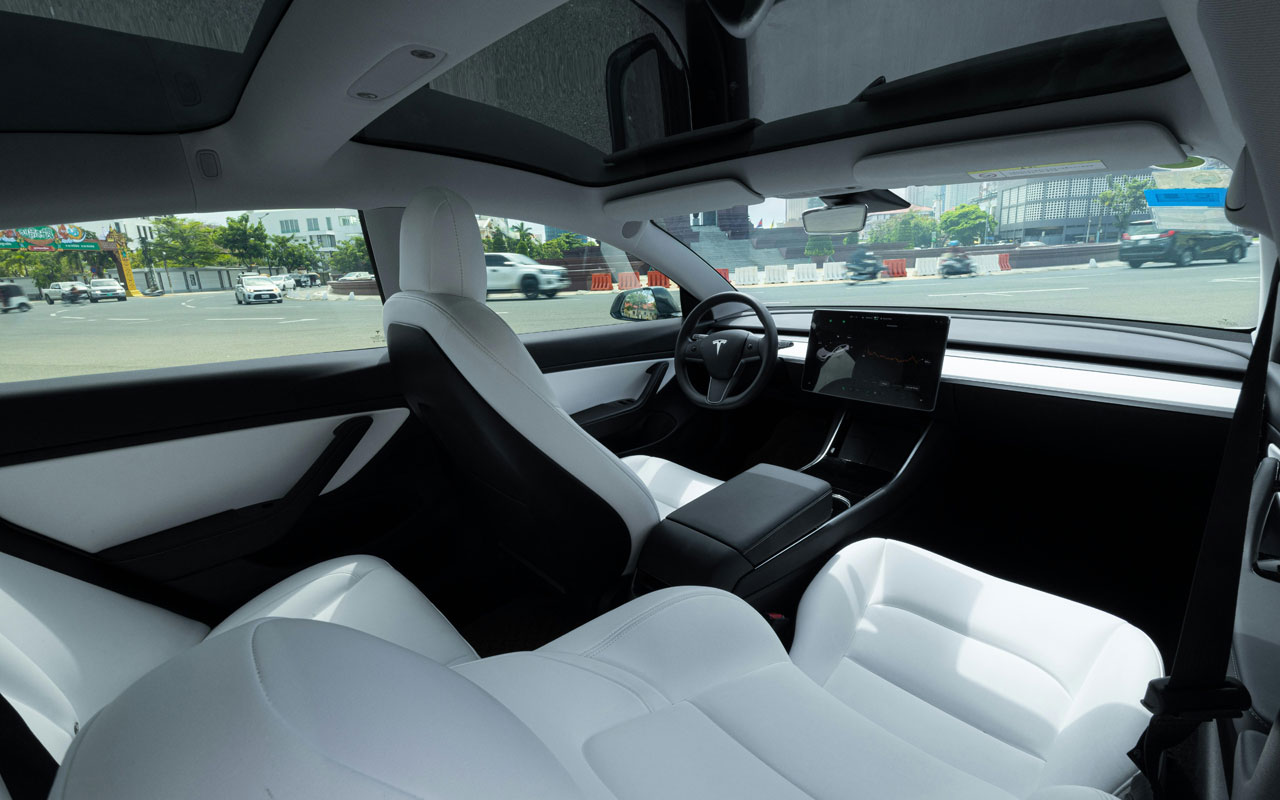
Inside A Tesla’s Car. Pexels Image.
This article provides a detailed analysis of Tesla’s revenue by country, covering key markets such as the U.S., China, Norway, the Netherlands, and more.
Let’s take a look!
For other key statistics of Tesla, you may find more resources on this page: Tesla key stats.
Please use the table of contents to navigate this page.
Table Of Contents
Definitions And Overview
O2. Why is Tesla’s revenue from the U.S. and China slowing down?
Insight & Summary of Observed Trends
Z1. Insight & Summary of Tesla’s Revenue By Country
Revenue Numbers By Country
A1. U.S., China, Norway, Netherlands, Others, Total Revenue – Revenue Numbers
Revenue Mix By Country
A2. U.S., China, Norway, Netherlands, Others, Total Revenue – Revenue Mix
Revenue Growth By Country
A3. U.S., China, Norway, Netherlands, Others, Total Revenue – Revenue Growth
Reference, Credits, and Disclosure
S1. References and Credits
S2. Disclosure
Definitions
To help readers understand the content better, the following terms and glossaries have been provided.
Revenue By Country: Tesla categorizes its revenues by geographic area, determined by the location where its products are sold.
Why is Tesla’s revenue from the U.S. and China slowing down?
Tesla’s revenue slowdown in the U.S. and China can be attributed to several key factors:
-
Increased Competition:
- In both the U.S. and China, Tesla faces growing competition from traditional automakers and new electric vehicle (EV) manufacturers. In China, local EV brands like BYD have gained significant market share, challenging Tesla’s dominance.
-
Production Challenges:
- Tesla has encountered production challenges, such as the redesign of the Model Y, which affected production at its Shanghai Gigafactory. These production adjustments have impacted Tesla’s ability to meet demand.
-
Economic Factors:
- Economic conditions, including inflation and changes in consumer spending, have influenced the demand for Tesla vehicles. In the U.S., economic uncertainties have affected consumer purchasing power.
-
Political and Trade Issues:
- Concerns about a potential China-U.S. trade war have created uncertainties for Tesla’s operations and sales in both countries. Political controversies involving Tesla’s CEO, Elon Musk, have also impacted the company’s reputation and sales.
-
Market Saturation:
- In key markets like California, where Tesla once dominated, the market has become saturated, leading to a decline in sales. Other brands have seen an increase in sales, while Tesla’s numbers have fallen.
-
Seasonal and Cultural Factors:
- In China, seasonal factors such as the Chinese Spring Festival have contributed to a temporary slowdown in sales. Additionally, cultural preferences and shifts in consumer behavior have influenced Tesla’s market performance.
These factors collectively explain the decline in Tesla’s revenue in the U.S. and China. As the EV market continues to evolve, Tesla will need to navigate these challenges and adapt its strategies to maintain its competitive edge.
Insight & Summary of Tesla’s Revenue and Profit Margin By Segment
The following analysis consolidates the trends observed across Tesla revenue by country for the 2015–2025 period.
-
The United States is Tesla’s dominant and structurally entrenched market. U.S. revenue grew from $1.96B in 2015 to $47.6B in 2025, with a 3-year average of $46.9B — representing 48.6% of total revenue. After a volatile period in 2018–2019 that saw share swing between 51.5% and 69.3% depending on delivery timing and international capacity, the U.S. share has stabilized in the 47–50% range since 2022. Growth has decelerated sharply — from 69.2% in 2022 to just -0.2% in 2025 — a near-stagnation that reflects U.S. market saturation in Tesla’s existing price tiers and intensifying competition from both domestic and imported EV rivals. The 3-year average growth of 5.6% is Tesla’s most modest domestic performance since the company’s early scaling years.
-
China is the second-largest market and the most strategically critical growth driver — until it wasn’t. China revenue surged from $319M in 2015 to a peak of $21.7B in 2023, fueled by the Shanghai Gigafactory ramp and strong domestic EV adoption. Its revenue share peaked at 25.7% in 2021 before settling to a 3-year average of 22.0%. However, the trajectory has recently reversed: China revenue contracted -3.7% in 2024 before nearly flatlined at +0.1% in 2025, yielding a 3-year average growth of just 5.4% — essentially matching the company average despite once being the engine of hypergrowth. Intensifying domestic competition from BYD, SAIC, and other local brands, combined with Tesla’s pricing reductions that compress both volume momentum and revenue quality, have eroded the growth premium China once carried. The market remains indispensable in scale but is no longer a source of incremental outperformance.
-
Norway and the Netherlands — once meaningful disclosures — disappeared from reporting after 2019. Both countries were disclosed separately through 2019 (Norway from 2015, the Netherlands from 2017), reflecting their early-adopter importance in the European EV ecosystem. Norway at its peak contributed $1.2B (4.9% of revenue) and the Netherlands $1.6B (6.5%) in 2019. Their consolidation into “Other Countries” from 2020 onward — likely due to falling below materiality thresholds as Tesla’s total revenue scaled — makes direct trend analysis impossible from 2020 onwards, and no average is calculable for the 2023–2025 window.
-
Other Countries is the largest share category outside the U.S. and reflects Europe’s collective weight. The “Other Countries” bucket — which encompasses Europe (excluding the separately reported countries), Asia-Pacific ex-China, and the rest of the world — has contributed a 3-year average of 28.4B and 29.4% of revenue. This segment grew at 30.9% in 2023 but contracted -2.6% in 2024 and -9.6% in 2025, yielding a 3-year average growth of 6.2% — barely above U.S. and China growth. The 2024–2025 contraction likely reflects softening European EV demand, competitive pressure from Chinese exports, and some demand pull-forward from earlier subsidized purchase cycles.
-
Structural Takeaway: Tesla’s geographic revenue story has converged toward a mature two-market model: the U.S. and China together account for approximately 70% of revenue, with “Other Countries” providing a stable but decelerating third block. All three major reporting segments are now growing at low single-digit rates or contracting, a marked departure from the 50–100%+ growth rates seen in 2021–2022. The elimination of Norway and Netherlands as discrete disclosures limits granularity in the European breakdown. For investors, the key forward question is whether any geography — or whether a new product category such as energy storage or FSD licensing — can restore the growth differential that vehicle sales across all regions have lost.
The table below combines all key revenue metrics into a single view for the latest three fiscal years.
Tesla Revenue by Country — Consolidated Averages (FY2023–2025)
| Country / Region | Average (2023–2025) |
|---|---|
| Revenue Numbers (US$ Millions) | |
| United States | 46,862 |
| China | 21,217 |
| Norway * | N/A |
| Netherlands * | N/A |
| Other Countries | 28,351 |
| Total Revenue | 96,430 |
| Revenue Mix (%) | |
| United States | 48.6% |
| China | 22.0% |
| Norway * | N/A |
| Netherlands * | N/A |
| Other Countries | 29.4% |
| Total Revenue | 100.0% |
| Revenue Growth (%) | |
| United States | 5.6% |
| China | 5.4% |
| Norway * | N/A |
| Netherlands * | N/A |
| Other Countries | 6.2% |
| Total Revenue | 5.6% |
* Norway and Netherlands were reported separately through FY2019 only; consolidated into Other Countries from FY2020 onwards.
U.S., China, Norway, Netherlands, Others, Total Revenue – Revenue Numbers
View data as table
Tesla Revenue by Country — All Metrics by Fiscal Year
| Fiscal Year | United States | China | Norway | Netherlands | Other Countries | Total Region |
|---|---|---|---|---|---|---|
| 2015 | $1,957M | $319M | $356M | n.a. | $1,414M | $4,046M |
| 2016 | $4,201M | $1,065M | $336M | n.a. | $1,399M | $7,001M |
| 2017 | $6,221M | $2,027M | $823M | $331M | $2,357M | $11,759M |
| 2018 | $14,872M | $1,757M | $813M | $965M | $3,054M | $21,461M |
| 2019 | $12,653M | $2,979M | $1,201M | $1,590M | $6,155M | $24,578M |
| 2020 | $15,207M | $6,662M | n.a. | n.a. | $9,667M | $31,536M |
| 2021 | $23,973M | $13,844M | n.a. | n.a. | $16,006M | $53,823M |
| 2022 | $40,553M | $18,145M | n.a. | n.a. | $22,764M | $81,462M |
| 2023 | $45,235M | $21,745M | n.a. | n.a. | $29,793M | $96,773M |
| 2024 | $47,725M | $20,944M | n.a. | n.a. | $29,021M | $97,690M |
| 2025 | $47,627M | $20,962M | n.a. | n.a. | $26,238M | $94,827M |
The definition of Tesla’s revenue categorized by country is available here: revenue by country.
Tesla Revenue by Country — Average Revenue Numbers (US$ Millions) (FY2023–2025)
| Country / Region | Average (2023–2025) |
|---|---|
| United States | 46,862 |
| China | 21,217 |
| Norway * | N/A |
| Netherlands * | N/A |
| Other Countries | 28,351 |
| Total Revenue | 96,430 |
* Norway and Netherlands were reported separately through FY2019 only; consolidated into Other Countries from FY2020 onwards.
U.S., China, Norway, Netherlands, Others, Total Revenue – Revenue Mix
View data as table
Tesla Revenue Mix by Country — All Metrics by Fiscal Year
| Fiscal Year | United States | China | Norway | Netherlands | Other Countries |
|---|---|---|---|---|---|
| 2015 | 48.4% | 7.9% | 8.8% | n.a. | 34.9% |
| 2016 | 60.0% | 15.2% | 4.8% | n.a. | 20.0% |
| 2017 | 52.9% | 17.2% | 7.0% | 2.8% | 20.0% |
| 2018 | 69.3% | 8.2% | 3.8% | 4.5% | 14.2% |
| 2019 | 51.5% | 12.1% | 4.9% | 6.5% | 25.0% |
| 2020 | 48.2% | 21.1% | n.a. | n.a. | 30.7% |
| 2021 | 44.5% | 25.7% | n.a. | n.a. | 29.7% |
| 2022 | 49.8% | 22.3% | n.a. | n.a. | 27.9% |
| 2023 | 46.7% | 22.5% | n.a. | n.a. | 30.8% |
| 2024 | 48.9% | 21.4% | n.a. | n.a. | 29.7% |
| 2025 | 50.2% | 22.1% | n.a. | n.a. | 27.7% |
The definition of Tesla’s revenue categorized by country is available here: revenue by country.
Tesla Revenue by Country — Average Revenue Mix (%) (FY2023–2025)
| Country / Region | Average (2023–2025) |
|---|---|
| United States | 48.6% |
| China | 22.0% |
| Norway * | N/A |
| Netherlands * | N/A |
| Other Countries | 29.4% |
| Total Revenue | 100.0% |
* Norway and Netherlands were reported separately through FY2019 only; consolidated into Other Countries from FY2020 onwards.
U.S., China, Norway, Netherlands, Others, Total Revenue – Revenue Growth
View data as table
Tesla Revenue Growth by Country — All Metrics by Fiscal Year
| Fiscal Year | United States | China | Norway | Netherlands | Other Countries | Total Region |
|---|---|---|---|---|---|---|
| 2016 | 114.7% | 233.9% | -5.6% | n.a. | -1.1% | 73.0% |
| 2017 | 48.1% | 90.3% | 144.9% | n.a. | 68.5% | 68.0% |
| 2018 | 139.1% | -13.3% | -1.2% | 191.5% | 29.6% | 82.5% |
| 2019 | -14.9% | 69.6% | 47.7% | 64.8% | 101.5% | 14.5% |
| 2020 | 20.2% | 123.6% | n.a. | n.a. | 57.1% | 28.3% |
| 2021 | 57.6% | 107.8% | n.a. | n.a. | 65.6% | 70.7% |
| 2022 | 69.2% | 31.1% | n.a. | n.a. | 42.2% | 51.4% |
| 2023 | 11.5% | 19.8% | n.a. | n.a. | 30.9% | 18.8% |
| 2024 | 5.5% | -3.7% | n.a. | n.a. | -2.6% | 0.9% |
| 2025 | -0.2% | 0.1% | n.a. | n.a. | -9.6% | -2.9% |
The definition of Tesla’s revenue categorized by country is available here: revenue by country.
Tesla Revenue by Country — Average Revenue Growth (%) (FY2023–2025)
| Country / Region | Average (2023–2025) |
|---|---|
| United States | 5.6% |
| China | 5.4% |
| Norway * | N/A |
| Netherlands * | N/A |
| Other Countries | 6.2% |
| Total Revenue | 5.6% |
* Norway and Netherlands were reported separately through FY2019 only; consolidated into Other Countries from FY2020 onwards.
Credits and References
1. All financial figures presented were obtained and referenced from Tesla’s annual reports published on the company’s investor relations page: Tesla Update Letters and Presentations.
2. Pexels Images.
Back To Table Of Contents
Disclosure
We may use the assistance of artificial intelligence (AI) tools to produce some of the text in this article. However, the data is directly obtained from original sources (usually the quarterly and annual reports) and meticulously cross-checked by our editors multiple times to ensure its accuracy and reliability.
If you find the information in this article helpful, please consider sharing it on social media. Additionally, providing a link back to this article from any website can help us create more content like this in the future.
Thank you for your support and engagement! Your involvement helps us continue to provide high-quality, reliable content.