
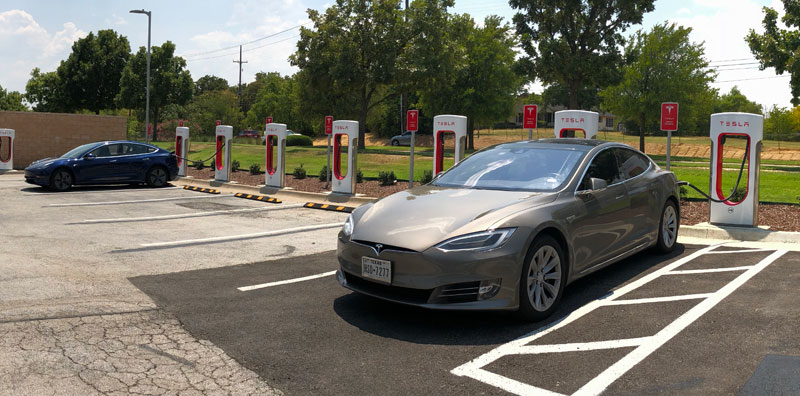
Tesla supercharger stations at Southlake, Texas. Source: Flickr
To support the world’s transition from fossil fuels to clean energy, Tesla (NASDAQ: TSLA) has established a global network of infrastructure that is crucial to its operations and success.
This extensive network includes a variety of buildings and vehicles, such as supercharger stations, mobile service vehicles, and numerous stores and service locations that tirelessly serve Tesla’s mission.
These infrastructure assets are some of Tesla’s most valuable assets, playing a pivotal role in generating revenue and setting Tesla apart from its competitors.
Beyond their monetary value, these assets provide Tesla with significant competitive advantages by creating substantial barriers to entry for other companies.
Establishing such a network requires years of effort and a vast amount of resources, making it difficult for others to replicate.
Let’s take a look!
For other key statistics of Tesla, you may find more resources on this page: Tesla key stats.
Please use the table of contents to navigate this page.
Table Of Contents
Definitions And Overview
O2. Are Tesla’s Superchargers free to use?
Insight & Summary of Observed Trends
Z1. Insight & Summary of Tesla’s Network of Infrastructures
Infrastructure Numbers & Growth
A1. Supercharger Stations
A2. Mobile Service Fleet
A3. Stores and Service Locations
Reference, Credits, and Disclosure
S1. References and Credits
S2. Disclosure
Definitions
To help readers understand the content better, the following terms and glossaries have been provided.
Superchargers: Tesla’s Superchargers are a network of high-speed charging stations designed to charge Tesla electric vehicles quickly. They are strategically located along popular highways and city centers, making long-distance travel more convenient and accessible for Tesla owners.
The Superchargers can deliver up to 170 miles of range in just 30 minutes of charging time, allowing drivers to quickly and easily recharge their vehicles while on the go. The stations are powered by renewable energy sources, such as solar and wind power, making them a more sustainable transportation option.
Mobile Service Fleet: Tesla’s mobile service fleet consists of technicians who travel to Tesla owners’ homes or workplaces to perform vehicle maintenance and repairs.
The service fleet is equipped with all the necessary tools and parts to address common issues and perform routine maintenance, such as tyre rotations or brake replacements. This service is designed to make it more convenient for Tesla owners to maintain their vehicles without taking them to a service center.
Stores And Service Locations: Tesla’s stores and service locations are physical locations where customers can purchase Tesla vehicles, receive information about Tesla products, and get support for their Tesla vehicles after purchase.
These locations are typically found in high-traffic areas, such as shopping malls or city centers, and are designed to provide customers with a unique and engaging experience. Tesla’s stores and service locations also offer maintenance and repair services for Tesla vehicles, test drives and product demonstrations.
The company aims to create a seamless and enjoyable customer experience at every stage of the vehicle ownership process, from purchase to maintenance and beyond.
Are Tesla’s Superchargers free to use?
No, Tesla’s Superchargers are not free. While some early Tesla models had unlimited free Supercharging, most new Tesla vehicles are now sold with a Supercharging fee.
The cost of Supercharging varies by location and electricity rates and can be viewed on the vehicle’s touchscreen or in the Tesla mobile app. However, Tesla occasionally offers free Supercharging as a promotion to incentivize purchases or to reward existing Tesla owners.
Insight & Summary of Tesla’s Network of Infrastructures
The following analysis consolidates the trends observed across Tesla’s network of infrastructures for the 2016–2025 period.
-
Supercharger Stations: Consistent, compounding expansion with decelerating growth. The Supercharger network has grown from 790 stations in 2016 to 8,182 in 2025 — a 10x increase over nine years, and the most consistently expanding infrastructure category in Tesla’s portfolio. Growth was strong and relatively stable through 2022 (averaging 30–40% per year), before decelerating to 27.2% in 2023, 17.2% in 2024, and 17.3% in 2025. The 3-year average growth of 20.6% is healthy by any absolute standard, but the trajectory clearly signals a maturing network approaching saturation in its core markets. Importantly, the Supercharger network’s strategic value extends beyond Tesla: beginning in 2023, Tesla opened its network to non-Tesla EVs in North America, transforming the charging infrastructure from a customer retention tool into a potential revenue stream and industry standard. This shift adds commercial and policy dimensions to what was previously purely a competitive moat.
-
Mobile Service Fleet: Strong growth through 2022, then a sharp plateau — and a data gap in 2025. The mobile service fleet grew from 230 units in 2017 to 1,933 in 2024, supported by consistent 20–80% annual growth rates during the scaling years. However, growth collapsed to just 1.3% in 2024, suggesting the fleet has reached a near-steady-state level relative to current vehicle volume and service demand. The absence of 2025 data means the 3-year average is based on only 2023–2024 (1,921 units, 10.9% growth). Whether the non-disclosure reflects a deliberate strategic choice to deemphasize mobile service, a reporting change, or simply an omission is unclear — but the plateauing trend ahead of the data gap is notable given that Tesla’s service capacity has been a recurring pain point for owners as the vehicle fleet has scaled to over 6 million cars globally.
-
Stores & Locations: Steady and predictable growth, accelerating in 2022. The retail and service footprint expanded from 265 locations in 2016 to 1,553 in 2025, with a 3-year average of 1,373 locations and 17.4% average growth. The most notable year was 2022, when stores grew 49.5% — likely driven by a deliberate push to expand physical presence in new markets and support the Model Y volume ramp. Growth has since normalized to 12–14% per year, suggesting a steady, market-penetration-driven cadence rather than a step-change acceleration. Unlike the Supercharger network, retail and service locations require significant real estate, permitting, and staffing investment, which may naturally cap the expansion pace.
-
Cross-infrastructure comparison. Supercharger stations represent Tesla’s most visible and strategically differentiated infrastructure asset — particularly given the network’s opening to non-Tesla vehicles — while stores and service locations provide the traditional physical touchpoints of an automotive brand. The mobile service fleet, though harder to quantify strategically, directly addresses the challenge of scaling service quality with a growing on-road fleet in a direct-to-consumer model that lacks independent dealerships. All three infrastructure categories have decelerated in growth rate over the most recent three years, consistent with Tesla’s broader transition from a high-growth startup to a maturing global automaker managing profitability alongside scale.
-
Structural Takeaway: Tesla’s infrastructure build-out across all three categories has been substantial and disciplined. The Supercharger network’s evolution into an open, monetizable platform is the most strategically significant development in this dataset. The mobile service fleet plateau and data gap warrant monitoring, as service quality is a known friction point in Tesla’s customer experience. For investors, the deceleration in all three categories is not alarming — it reflects maturation — but it underscores that the infrastructure investment phase requiring heavy capex is giving way to a network optimization phase requiring operational excellence.
The table below combines all key infrastructure metrics into a single view for the latest three fiscal years.
Tesla Infrastructure — Consolidated Averages
| Metric | Average |
|---|---|
| Supercharger Stations (FY2023–2025) | |
| Supercharger Stations (Units) | 7,036 |
| Supercharger Stations Growth (%) | 20.6% |
| Mobile Service Fleet * (FY2023–2024) | |
| Mobile Service Fleet (Units) | 1,921 |
| Mobile Service Fleet Growth (%) | 10.9% |
| Stores & Locations (FY2023–2025) | |
| Stores & Locations (Units) | 1,373 |
| Stores & Locations Growth (%) | 17.4% |
* Mobile Service Fleet FY2025 data not reported; average based on FY2023–2024 only.
Supercharger Stations
View data as table
Tesla Supercharger Stations — All Metrics by Fiscal Year
| Fiscal Year | Supercharger Stations | Supercharger Stations Growth |
|---|---|---|
| 2016 | 790 | n.a. |
| 2017 | 1,128 | 42.8% |
| 2018 | 1,421 | 26.0% |
| 2019 | 1,821 | 28.1% |
| 2020 | 2,564 | 40.8% |
| 2021 | 3,476 | 35.6% |
| 2022 | 4,678 | 34.6% |
| 2023 | 5,952 | 27.2% |
| 2024 | 6,975 | 17.2% |
| 2025 | 8,182 | 17.3% |
The definition of Tesla’s supercharger stations is available here: Superchargers.
Tesla Supercharger Stations — Averages (FY2023–2025)
| Metric | Average (2023–2025) |
|---|---|
| Supercharger Stations (Units) | 7,036 |
| Supercharger Stations Growth (%) | 20.6% |
Mobile Service Fleet
View data as table
Tesla Mobile Service Fleet — All Metrics by Fiscal Year
| Fiscal Year | Mobile Service Fleet | Mobile Service Fleet Growth |
|---|---|---|
| 2016 | n.a. | n.a. |
| 2017 | 230 | n.a. |
| 2018 | 411 | 78.7% |
| 2019 | 743 | 80.8% |
| 2020 | 894 | 20.3% |
| 2021 | 1,281 | 43.3% |
| 2022 | 1,584 | 23.7% |
| 2023 | 1,909 | 20.5% |
| 2024 | 1,933 | 1.3% |
| 2025 | n.a. | n.a. |
The definition of Tesla’s mobile service fleet is available here: mobile service fleet.
Tesla Mobile Service Fleet — Averages (FY2023–2024) *
| Metric | Average (2023–2024) |
|---|---|
| Mobile Service Fleet (Units) | 1,921 |
| Mobile Service Fleet Growth (%) | 10.9% |
* FY2025 data not reported; average based on FY2023–2024 only.
Stores and Service Locations
View data as table
Tesla Stores & Locations — All Metrics by Fiscal Year
| Fiscal Year | Stores & Locations | Stores & Locations Growth |
|---|---|---|
| 2016 | 265 | n.a. |
| 2017 | 330 | 24.5% |
| 2018 | 378 | 14.5% |
| 2019 | 429 | 13.5% |
| 2020 | 523 | 21.9% |
| 2021 | 644 | 23.1% |
| 2022 | 963 | 49.5% |
| 2023 | 1,208 | 25.4% |
| 2024 | 1,359 | 12.5% |
| 2025 | 1,553 | 14.3% |
The definition of Tesla’s stores and service locations is available here: stores and service locations.
Tesla Stores & Locations — Averages (FY2023–2025)
| Metric | Average (2023–2025) |
|---|---|
| Stores & Locations (Units) | 1,373 |
| Stores & Locations Growth (%) | 17.4% |
References and Credits
1. All data presented were obtained and referenced from Tesla’s update letters published on the company’s investor relations page: Tesla Press Releases.
2. Tesla supercharger detailed info: Tesla charging infrastructure.
3. Flickr Images.
Back To Table Of Contents
Disclosure
We may utilize the assistance of artificial intelligence (AI) tools to produce some of the text in this article. However, the data is directly obtained from original sources (usually the quarterly and annual reports) and meticulously cross-checked by our editors multiple times to ensure its accuracy and reliability.
If you find the information in this article helpful, please consider sharing it on social media. Additionally, providing a link back to this article from any website can help us create more content like this in the future.
Thank you for your support and engagement! Your involvement helps us continue to provide high-quality, reliable content.